Any cancer diagnosis is difficult to grapple with—each case is individual and has its own set of challenges. One of the reasons a lung cancer diagnosis can be especially emotional is because of its stigmatization, says Andrew Popoff, M.D., a thoracic surgeon at Henry Ford Health.
“People facing a diagnosis of lung cancer can experience guilt because there’s some sense that their behavior contributed to it," says Dr. Popoff. "There’s a thought that lung cancer happens only to smokers, which isn’t true. Up to 20% of lung cancers can occur in non or never smokers. Overcoming lung cancer stigmatization is important. We need to break down those barriers and help people talk about lung cancer more openly to ensure those at risk are getting annual screenings in order to catch it at early, treatable stages.”
To get the conversation going, Dr. Popoff shares everything you need to know about lung cancer.
What’s happening to your body when you have lung cancer?
Dr. Popoff: Those with lung cancer have overactive, abnormally growing and dividing cells in their lungs, forming a tumor. If left untreated, this tumor can continue to reproduce and spread to the lymph nodes, liver, adrenal glands, bones, brain and pleura, or the lining of the chest cavity.
What are the symptoms of lung cancer?
Dr. Popoff: A deep cough that won’t go away, fatigue, shortness of breath, chest pain, hoarseness, wheezing, chronic infections of bronchitis or pneumonia, coughing up blood and unexplained weight loss. The trouble is that many of these are non-specific symptoms. Many things can cause fatigue, for example. Also, these are symptoms of advanced lung cancer, and we want to catch lung cancer at an early stage.
Many people don’t experience symptoms in lung cancer’s early stages, which is why it’s important to get a screening for early detection.
Who should get a lung cancer screening?
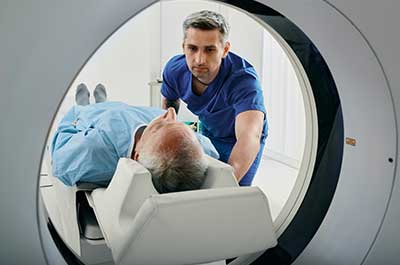
Dr. Popoff: The American Cancer Society recommends annual lung cancer screening for people ages 50 to 80 who currently smoke or who have quit within the past 15 years and smoked at least one pack a day for 20 years or more (20-pack years) or the equivalent (for example, you may have smoked two packs a day for 10 years).
Until 2015, there weren’t well-established screening guidelines for lung cancer. Even now, less than 10% of eligible patients are screened. Lung cancer kills more people than colon, breast and prostate cancers combined. If your cancer is detected at an early stage by screening, you can dramatically impact your mortality rate. A stage one lung cancer patient has a 70% to 90% five-year survival rate, while a stage-four patient has less than a 5% survival rate.
What are the risk factors for lung cancer?
Dr. Popoff: Smoking is the number one risk factor—about 80% of lung cancers occur in smokers or former smokers. However, that means up to 20% of cases occur in non or never-smokers. Secondhand smoke, exposure to industrial asbestos and radon gas (a naturally occurring, radioactive gas that’s colorless and odorless and found in the soil in certain areas of Michigan) can also cause lung cancer. Radon can enter the basement through cracks in the foundation. There are at-home test kits for radon, but unless you test for it, there isn’t any other means of identifying it.
Thirdhand smoke (or the toxic chemicals from smoke that linger on clothes, surfaces and hair) also contribute to lung cancer, but it’s difficult to quantify the risk. The relationship between thirdhand smoke and lung cancer is quite unknown. Most people know how much they smoke a day, but the degree of exposure to thirdhand smoke is hard to assess.

Cancer Care at Henry Ford
Is there a genetic component to lung cancer?
Dr. Popoff: If you have a family history of lung cancer, you’re more likely to get lung cancer than those who don’t have a family history of lung cancer, but that’s only about an 8% increase in the likelihood that you’ll get it. With lung cancer, genetics factor in, but the biggest risk factor is smoking.
How is lung cancer treated?
Dr. Popoff: Stage one and two are generally treated with surgery. Stages three and four are usually a combination of surgery, chemotherapy or immunotherapy, depending upon the stage and aggressiveness of the cancer.
Immunotherapy, which boosts your natural immune system to better attack cancer cells, has gained a lot of favor in recent years, particularly for those with advanced disease.
Does vaping cause lung cancer?
Dr. Popoff: We don't have a lot of scientific research on vaping yet, because large numbers of vapers haven't been present until the past few years. It's going to take time to see the influence of vaping on lung disease and cancer in general. We know vaping is not safe, and we've certainly seen cases of acute lung injury with vaping (which is thought to be caused by vaporized vitamin E and can be highly toxic to lung tissue), but there's a lot more research that needs to be done.
Reviewed by Andrew Popoff, MD, FACS, a board-certified thoracic surgeon and fellowship-trained thoracic surgical oncologist specializing in lung and thoracic cancer surgery. He sees patients at Henry Ford Cancer - Detroit and Henry Ford Hospital in Detroit.