A Life-Saving Colorectal Cancer Screening
At 45, Brooke had her first routine colorectal cancer screening. It caught her colon cancer early, before it could spread.

Colorectal cancer is one of the most treatable cancers when caught early. Henry Ford Health welcomes Canadian patients for colorectal cancer screening — with same-area convenience, experienced specialists, and a program built around catching cancer before it becomes harder to treat.
Our cancer experts recommend colorectal cancer screening starting at age 45 and continuing until age 75 for those with an average risk. If you are at an increased risk for colorectal cancer, start screening at age 40 or as recommended by your doctor.
Screening tests look for different signs, such as:
Polyps are the most common sign of colon cancer, rectal cancer and anal cancer. Polyps can be harmless (benign), precancerous (may turn into cancer) or cancerous. We can often remove polyps during a colonoscopy, the most common colorectal cancer screening test. We test the polyps to find out if they’re cancerous.
Request an appointment and we'll take care of the rest.
Cancer screenings are tests you have regularly to catch cancer early. Screening looks for cancer before symptoms appear. Diagnostic tests check you after symptoms appear or evaluate problems we detected during screening. Colorectal cancer screening checks for signs of cancer in your colon, rectum or anus.
Screening tests look for different signs, such as:
Polyps are the most common sign of colon cancer, rectal cancer and anal cancer. Polyps can be harmless (benign), precancerous (may turn into cancer) or cancerous. We can often remove polyps during a colonoscopy, the most common colorectal cancer screening test. We test the polyps to find out if they’re cancerous.

At Henry Ford, we recommend the screening test that’s right for your age, health and risk level. While a colonoscopy is the most common colorectal cancer screening test, it may not be right for everyone. Our personalized approach means you always receive the best test for your needs.
The two main types of colorectal cancer screening tests are:
Stool tests for colon cancer check for hidden blood in your stool or cells with abnormal DNA changes. Stool tests, such as Cologuard®, are usually at-home tests. You collect a stool sample and send it to the lab. If you get an abnormal result from a stool test, you’ll need a visual exam such as a colonoscopy. Stool tests might be appropriate for people not healthy enough for a colonoscopy.
Visual tests, such as a colonoscopy or flexible sigmoidoscopy, examine your colon and rectum. Your doctor inserts a scope (flexible tube) into your anus to look for polyps. A virtual colonoscopy uses X-rays and CT scans instead of a scope to examine your large intestine. You may get a virtual colonoscopy if you can’t have the sedation necessary for a standard colonoscopy.
Many people wonder about the differences between a colonoscopy and an at-home colorectal cancer test. At-home tests are less invasive and more convenient, but they’re less accurate than colonoscopies. You also need at-home testing more often (every one to three years), while you only need a colonoscopy every 10 years if you’re at an average risk. Learn more about at-home alternatives to colonoscopy.
| Colonoscopy |
At-home Colon Screening |
|---|---|
| Preparation required |
No preparation required |
| Most sensitive test — considered gold standard — for colon cancer screening | Less sensitive than a colonoscopy at detecting pre-cancerous polyps |
| Polyps can be removed during the screening exam | Not recommended if family history of colon cancer, previous cancer, or colon/rectum disease |
| If polyps are found, the doctor informs immediately after screening | Polyps will not be removed |
| Receive results in three days or less | At-home test misses one out of 13 people with cancer that would be detectable by colonoscopy |
| Recommended repeat testing on the normal test is every 10 years | Results do not confirm whether cancer is present |
| If cancer is detected, a colonoscopy is needed to confirm the results and remove polyps | |
| Receive results up to two weeks later | |
| Recommended repeat testing every one to three years |
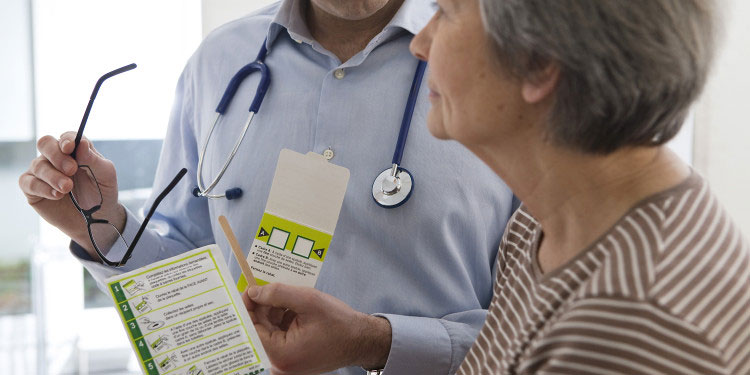
Learn more about the screening options for colorectal cancer and decide if an at-home test is right for you.
We use cookies to improve your website experience. By using this site, you agree to our Terms of Use. Read our Internet Privacy Statement to learn what information we collect and how we use it.