.svg?iar=0&hash=F6049510E33E4E6D8196C26CCC0A64A4)
/hfh-logo-main--white.svg?iar=0&hash=ED491CBFADFB7670FAE94559C98D7798)
PatenSee: Improving Comfort, Safety, and Outcomes for Dialysis Patients
For patients who rely on dialysis, improvements in comfort, safety, and early detection can make a meaningful difference in both daily treatment and long term health. Technologies that reduce pain, limit infection risk, and help clinicians identify problems sooner can significantly improve the dialysis experience while supporting better outcomes.
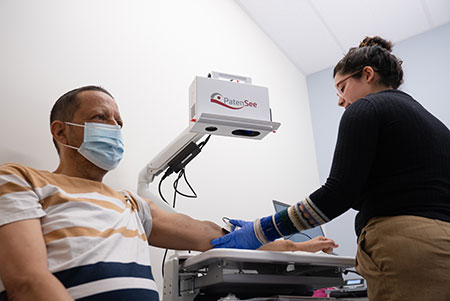 To address these challenges, Henry Ford Health is clinically evaluating new approaches designed to improve how dialysis care is delivered. One such approach involves PatenSee, an early stage medical device company developing a non contact imaging system that allows clinicians to quickly monitor vascular access—the critical connection point between a patient and the dialysis machine—without touching the patient.
Vascular access is a surgically created site where an artery and vein are joined, and it must remain healthy to ensure safe and effective treatment. Complications related to vascular access are a leading cause of morbidity in hemodialysis patients and can significantly reduce quality of life, making consistent and accurate monitoring essential.
For patients participating in the clinical trial, the decision to take part was an easy one.
“If this helps other patients in the future, that’s great,” said one participant. “They are skilled, and if I can help get them the data they need, that’s great.”
The patient has been on dialysis for 23 years.
Another patient, who has been on dialysis since 1995, shared a similar perspective.
“If it can help other people, I wanted to do it. They’ve been great to me. We can help them, and they can help us.”
PatenSee is designed to address three key challenges associated with vascular access monitoring:
- Time constraints: Dialysis clinics are extremely busy. Using PatenSee, clinical teams can assess a patient’s vascular access in about one minute, compared to approximately seven minutes using traditional methods.
- Infection risk: Traditional assessments require direct contact between clinicians and patients, increasing the risk of infection. PatenSee’s approach is completely non contact.
- Inconsistent exams: Manual checks can vary from one clinician to another. PatenSee supports more standardized assessments to aid clinical decision making.
The AI driven optical scanning device enables quick, non invasive monitoring of vascular access in the clinic or while patients wait for treatment. Machine learning algorithms analyze the scanned data to identify early signs of stenosis, helping clinicians intervene before complications develop.
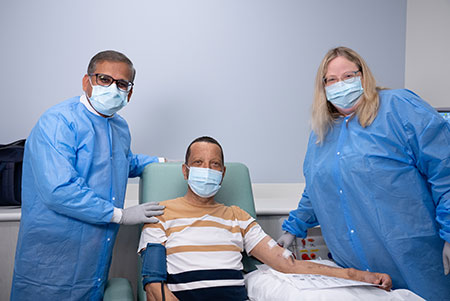 Routine monitoring remains a challenge for dialysis clinics, and technologies like PatenSee have the potential to support earlier detection, timely intervention, and fewer life threatening complications—while also improving patient comfort and reducing the burden on care teams.
Preliminary clinical validation involving 60 patients studied over 18 months demonstrated performance comparable to current standards of care. Building on those results, nephrologists Lalathaksha Kumbar, MD, and Sandeep S. Soman, MD, are leading an observational clinical trial involving 40 patients at Henry Ford Health to further evaluate the technology’s effectiveness in real world dialysis settings.
This work reflects Henry Ford Health’s broader commitment to advancing patient centered innovation. PatenSee is one of the early companies supported through the Henry Ford Health + MSU Innovation Hub, which helps promising health technology companies advance through clinical validation and real world testing.