.svg?iar=0&hash=F6049510E33E4E6D8196C26CCC0A64A4)

/hfh-logo-main--white.svg?iar=0&hash=ED491CBFADFB7670FAE94559C98D7798)
Michael’s Story – Gamma Tile Therapy for Advanced Colon Cancer
One Year After Being the World’s First Patient to Undergo Groundbreaking Therapy for Advanced Colon Cancer, Northville Resident Enjoys Improved Quality of Life
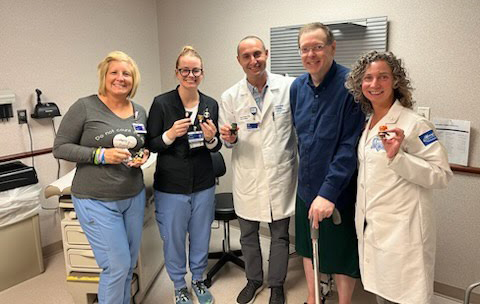 When Michael Baumstark was 55 years old, a subtle but alarming symptom changed life as he knew it.
“I noticed blood in my stool when I went to the bathroom,” recalls the former financial analyst. Following his doctor’s recommendation for a colonoscopy, Michael learned he had colon cancer that had spread to the bone—an uncommon and particularly complex diagnosis.
A rare and aggressive diagnosis
Cancer that spreads from the colon to the spine presents significant treatment challenges. For Michael, the location of the metastasis affected his mobility and caused increasing pain, making everyday activities difficult and limiting his quality of life.
Limited options with conventional treatment
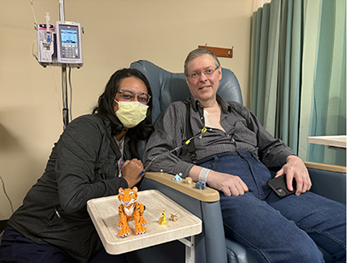 Michael underwent months of traditional treatment, including chemotherapy and radiation therapy. Despite these efforts, the cancer continued to progress.
“Parts of his spinal cord and other organs near his tumor had received significant radiation and additional conventional treatment would have been unacceptably toxic,” explains radiation oncologist at Henry Ford Health, M. Salim Siddiqui, M.D, Ph.D.
With limited standard options, the remaining alternative was high-risk surgery that carried the possibility of permanent nerve damage and the loss of Michael’s ability to walk.
Henry Ford Innovations opens a new door
Rather than accept those risks, a multidisciplinary team—including Dr. Siddiqui and Henry Ford Health neurosurgeon Adam Robin, M.D. looked for an innovative solution. Through Henry Ford Innovations, a hub dedicated to advancing patient care, the team explored whether an existing technology could be applied in a new way.
 Their answer was GammaTile therapy.
Although GammaTile had been used successfully at Henry Ford Health’s Hermelin Brain Tumor Center since 2021, it had never before been applied to spinal metastases from colorectal cancer. After careful review, Michael agreed to move forward—becoming the first patient in the world to receive GammaTile therapy to the spine for advanced colon cancer.
“It was a little scary at first,” Michael says. “But I was already dealing with a lot of pain and difficulty walking. When I learned about this option, I agreed to give it a try.”
What the treatment entails
GammaTile therapy is a form of surgically targeted radiation. After a tumor is removed, surgeons place postage–stamp–sized collagen tiles embedded with radiation seeds directly into the tumor cavity.
The tiles begin delivering radiation immediately, targeting cancer cells while minimizing exposure to surrounding healthy tissue. Over time, the body absorbs the collagen, and the radiation seeds naturally become inactive.
“GammaTile therapy offered a viable alternative to traditional surgery with continued radiation and chemotherapy because we could deposit the radiation tiles at the site of the tumor and deliver high levels of radiation without pushing surrounding organs, such as the colon, over the toxicity threshold,” explains Dr. Robin.
3D Printing: A shared tool for precision and passion
 Because the procedure had never been performed in this area of the body, preparation was critical. Dr. Robin and Dr. Siddiqui partnered with Henry Ford Innovations to create a 3D-printed model of Michael’s spine and tumor.
Using the model, the surgical team rehearsed the complex procedure in advance—practicing tumor removal and tile placement to ensure accuracy on the day of surgery.
For Michael, the use of 3D printing carried special significance.
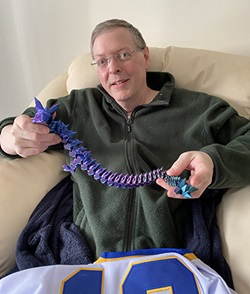
“Coincidentally, my main hobby is 3D printing miniature figurines—animals, sports teams, all kinds of things,” he says. “It was pretty amazing to see the same technology I use at home being used to help plan my surgery.”
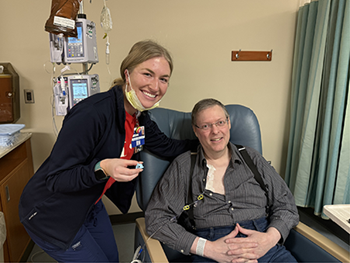
Michael has shared several of his 3D-printed figurines with hospital staff as a gesture of gratitude, a small but meaningful connection between his personal passion and the technology that played a role in his care.
A groundbreaking procedure and ongoing care
 The surgery was performed in September 2024. Following the procedure, Michael began lower-intensity maintenance chemotherapy with his medical oncologist, Philip Philip, M.D., to help keep the cancer under control.
“In complex cases like Michael’s,” Dr. Siddiqui says, “the question isn’t ‘Can we treat it?’ It’s ‘Can we treat it safely while preserving — and possibly improving — quality of life?’ That’s where Henry Ford thrives. We make a way to improve lives, ‘making the impossible possible,’ by combining surgical excellence, radiation innovation, physics precision, and a shared commitment to the person in front of us.”
Regaining mobility and looking ahead
Now, more than one year after his groundbreaking treatment, Michael says he is doing very well. Physical therapy has helped him regain strength and movement, and he encourages other patients to commit fully to rehabilitation.
“My pain has been reduced, and I can drive again,” he says. “I’m using a walker now, but my goal is to transition to a cane.”
Reflecting on his journey, Michael remains deeply appreciative of the care he received.
“I feel fortunate that I’m doing well,” he says. “The team at Henry Ford gave me an option that made all the difference.” His advice to others who have advanced colon cancer is to explore all options available. “Don’t give up hope. There are always new treatments like this that are being developed. I believe I would be in much worse shape if I had not undergone this treatment.”