.svg?iar=0&hash=F6049510E33E4E6D8196C26CCC0A64A4)

/hfh-logo-main--white.svg?iar=0&hash=ED491CBFADFB7670FAE94559C98D7798)
Carotid artery surgeries give Downriver deer hunter renewed strength and energy
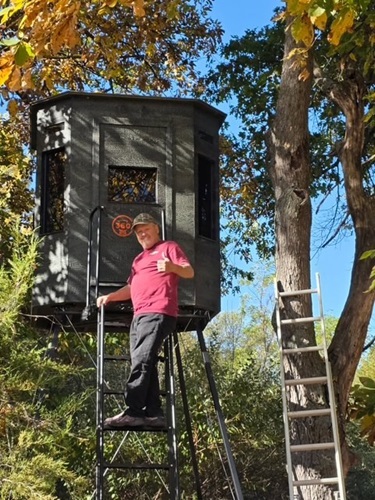 Avid deer hunter and Downriver resident Jeff Martin used to need a golf cart to get to his deer blind, but not anymore. Since having surgery at Henry Ford Wyandotte Hospital to open severe blockages in both carotid arteries, Jeff has been able to increase his physical activity without dizziness and without the risk of a stroke. “I feel 30 years younger,” he says.
For about five years prior, Jeff easily became tired and short of breath while walking or working around the house. He also had trouble sleeping and often felt lightheaded during the day. As the symptoms became worse, Jeff made an appointment with Henry Ford Cardiovascular Medicine – Brownstown.
Tests there revealed 80-percent blockages in both of Jeff’s carotid arteries, the large blood vessels located on either side of the neck. Caused by a buildup of calcium and plaque on the artery walls, these blockages were limiting the flow of oxygen-rich blood the brain needs to function. Because this put Jeff at high risk for stroke, he was referred to vascular surgeon Brian Sullivan, M.D., at Henry Ford Wyandotte Hospital.
Dr. Sullivan explained two surgical methods for increasing blood flow to the brain. The traditional surgical method, called carotid endarterectomy, opens the artery to remove the blockage. The newer, minimally invasive procedure, called transcarotid artery revascularization (TCAR for short), is performed through a smaller incision. TCAR temporarily reverses the direction of blood flow. This protects the brain while the surgeon inserts a balloon and stent to open the blocked artery—and keep it open.
Both methods have certain advantages. Determining which one is most appropriate for each patient depends on factors such as the individual’s age and overall health, as well as the existence of other medical conditions.
Jeff wanted to stay close to his home for treatment. At the time, Henry Ford Wyandotte Hospital was still waiting to be approved to offer the minimally invasive procedure. But Dr. Sullivan advised him to treat the left-side blockage immediately, because of Jeff’s high stroke risk.
Jeff agreed to first have a left-side carotid endarterectomy at Henry Ford Wyandotte Hospital, with a plan to have TCAR on the right side as soon as it became available there. “Dr. Sullivan explained everything thoroughly, in a way my wife and I could understand. We had total confidence in him and in our decision,” Jeff says.
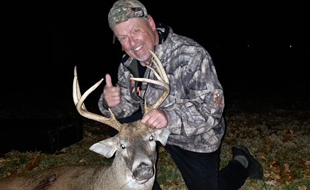 After about six weeks of recovery, Jeff was able to undergo minimally invasive surgery on his right side—becoming the first TCAR patient at Henry Ford Wyandotte Hospital. “The TCAR procedure was easier on me, but I am healing well on both sides,” Jeff says. “Dr. Sullivan did an amazing job both times. I’m grateful to his team and very happy that I didn’t have to travel for my treatment.”
Just three weeks after his TCAR surgery, Jeff was able to walk to his deer blind carrying his own gear. He also had the energy and stamina to pick up the leaves on his property. “It’s easier to do everything now,” Jeff says. “Life is good, and deer hunting is even more enjoyable.