.svg?iar=0&hash=F6049510E33E4E6D8196C26CCC0A64A4)

/hfh-logo-main--white.svg?iar=0&hash=ED491CBFADFB7670FAE94559C98D7798)
Schedule Your Screening
Colorectal cancer screening is the best way to catch pre-cancerous polyps early — when cancer is most treatable and curable. If you're 45 or older, don't wait. Schedule your screening today.

For more than two decades, Brooke Wessman took great pride in working for Henry Ford Health in administrative roles focused on health care process improvement.
“I consider Henry Ford my work family even though I left the organization a few years ago to focus on raising my daughters and help take care of my father,” says Brooke, who lives in Lasalle, Ontario and formerly served as director of growth improvement and integration radiology for the health system.
Her Henry Ford family became more important than she ever imagined when, at age 45, she underwent her first screening for colon cancer.
As someone who prioritizes healthy living — exercise, clean eating and routine screenings, Brooke received a colon cancer screening at age 45 with a Cologuard test. She was surprised when the results detected altered DNA and/or blood, a possible sign of precancerous polyps or colon cancer.
 Though anxious, Brooke wasn’t overly worried and knew that positive Cologuard tests could simply indicate polyps. A follow-up colonoscopy at Henry Ford Hospital was performed on September 3, 2025.
“When I saw the after-visit summary before the doctor came in, I knew it wasn’t good. The doctor then came in and told me I likely had colon cancer, which was confirmed the next day.”
Her mind became flooded with questions. How could this happen with no symptoms?
“I make it a priority to eat right with minimal processed foods, exercise and live a healthy life,” she says. “As alarming as this diagnosis was, I was told by Henry Ford doctors that more people are being diagnosed younger and with no symptoms, which is why screening recommendations now start at age 45.”
Without hesitation, Brooke reached out to her former colleagues, including members of the radiology team, for guidance — and found comfort knowing her work family would now be in charge of her care.
Henry Ford’s multidisciplinary colon cancer tumor board reviewed her test results and recommended a treatment plan including surgery to remove the tumor, followed by chemotherapy to eliminate microscopic cancer cells and help prevent recurrence.
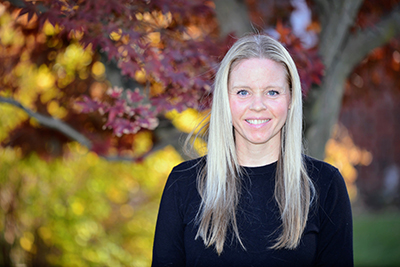 Brooke and her colon and rectal cancer surgeon Surya Nalamati, M.D., discussed the option of single-port robotic surgery, a newer minimally invasive technique offered at Henry Ford Health. Dr. Nalamati explains that instead of several incisions, the entire procedure is done through one small opening.
“This allows us to remove the cancer safely while helping patients experience less pain, quicker recovery, and a faster return to their normal activities,” he notes.
Dr. Nalamati shares that in Brooke’s case, she had a single tumor, but the standard operation is to remove the entire right colon rather than just the segment containing the cancer. “This ensures we achieve clear margins and remove the lymph nodes that drain that area, since lymph node involvement can influence the need for additional treatment,” he says. “Because she healed so well after surgery, she was able to begin the next recommended step without delay.”
Brooke says she quickly experienced the benefits of the minimally invasive procedure.
“Right after surgery, I was told that I should walk around to aid in my recovery,” she says. “I was discharged two days after surgery, and within two weeks, I couldn’t believe how good I felt considering I had just had major surgery.”
 With surgery complete, Brooke is undergoing chemotherapy managed by Ira Wollner, M.D., medical oncologist at Henry Ford Health.
He explains that when colon cancer is surgically removed, the pathologist will define a cancer stage from the operative specimen using the international system of staging for that cancer. Treatment decisions are based on the stage and published in national guidelines, which are updated regularly based on relevant published evidence in the medical literature. “Brooke’s cancer stage merited adjuvant treatment – treatment given after surgery to enhance the chance for cure,” he says. “The percentage of patients under the age of 50 being diagnosed with colorectal cancer has doubled over the last 20 years and Brooke is an example of this phenomenon. As a result of this increase, the age to start screening for colorectal cancer has dropped from 50 to 45.”


 Even with years of healthcare experience, becoming a patient gave her a unique perspective.
“As educated as I was about the industry, once you are faced with a diagnosis and you hear cancer, it’s incredible what you don’t absorb,” she says. “I was so grateful for my husband, who was by my side. We recorded appointments and even used AI to create summary sheets to help manage the care plan.”
She also credits her nurse navigator and coordinated care team, along with guidance from her former radiology colleagues, for keeping everything on track.
 “The care on all levels has been truly exceptional,” she emphasizes.
Brooke hopes her story pushes others to act — before symptoms appear.
“I received my colon cancer screening reminder through the Henry Ford patient portal and decided to take care of it at age 45. I believe that decision saved my life. I hope those reading this will be inspired to get screened. I am an example that it can truly make a life-changing difference.”
For Brooke, a big Lions fan, watching her favorite football team’s grit on and off the field has served as a source of inspiration as she recovers and moves on from this health chapter.
“I named my port access for chemotherapy LaPorta,” she says, referring to Sam LaPorta, tight end for the Detroit Lions.” We are both out for the rest of the season, but we will come back stronger next year!”
To learn more, visit Colon Cancer Care and Treatment at Henry Ford Health.
We use cookies to improve your website experience. By using this site, you agree to our Terms of Use. Read our Internet Privacy Statement to learn what information we collect and how we use it.