.svg?iar=0&hash=F6049510E33E4E6D8196C26CCC0A64A4)
/hfh-logo-main--white.svg?iar=0&hash=ED491CBFADFB7670FAE94559C98D7798)
Harnessing the power of our immune system to fight disease
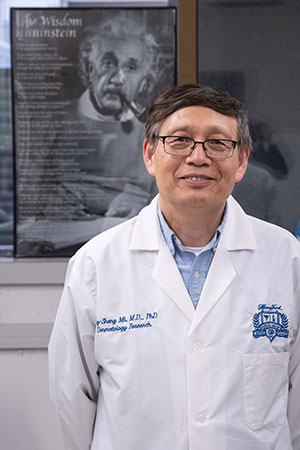
How do we keep the immune system in balance and can restoring that balance help us defeat disease? That is the driving question behind the work of Henry Ford researcher Qing-Sheng Mi, MD, PhD and his team in their quest to find new effective treatment options for the millions of people who live with chronic inflammatory diseases and cancer.
The Mi Lab at the Center for Cutaneous Biology and Immunology is part of Henry Ford Health + MSU Health Sciences. It’s focused on understanding how the skin and immune system interact, and especially in the earliest stages of disease.
“Our research focuses on the body’s first line of defense,” said Dr. Mi, Director of the Center for Cutaneous Biology and Immunology. “From chronic inflammatory diseases to cancer immunotherapy, understanding how to modulate immune cells behavior and restore immune balance is key to developing new treatments."
These examples of recent work illustrate why the Mi lab is at the forefront of precision medicine using immunotherapy concepts.
Battling the chronic inflammatory skin disease hidradenitis suppurativa
Hidradenitis suppurative (HS) is a chronic, debilitating inflammatory skin disease affecting 3 million people in the United States, primarily women. Characterized by painful, recurring lesions in sensitive areas of the body, HS remains notoriously difficult to treat: current treatments only work in about 40% of patients and many individuals ultimately require surgery. A large unmet clinical and commercial need exists for targeted, disease-modifying treatments.
Dr. Mi’s team identified a specific enzyme, called CD38, — a multifunctional enzyme highly expressed on inflammatory immune cells in both the blood and skin lesions of HS patients. In laboratory experiments, treatment with anti-CD38 antibodies significantly reduced inflammatory cytokines in HS skin lesions, supporting CD38 as a compelling therapeutic target. By repurposing FDA-approved anti-CD38 antibodies already used in multiple myeloma treatment, this approach offers a promising new treatment avenue for the millions of HS patients who do not respond to current biological therapies. The team is collaborating with pharmaceutical companies on an anti-CD38 clinical trial, recently funded by the National Institutes of Health (NIH)
In partnership with the Henry Ford Department of Dermatology clinical team — including world-renowned HS expert Dr. Iltefat Hamzavi — Dr. Mi's lab has built one of the largest HS research cohorts in the world, providing a powerful translational platform to uncover new disease mechanisms, identify biomarkers for HS precision medicine, and advance novel therapeutic targets. This work is currently supported by multiple funding sources, including two NIH R01 grants.
A better way to treat COVID-19
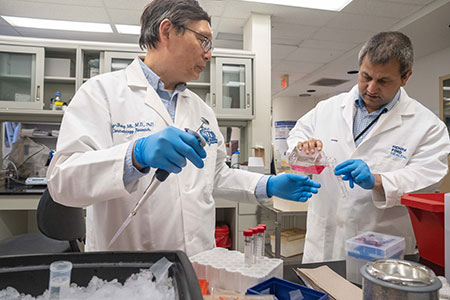
The team explored how SARS-CoV-2 virus infects immune cells, allowing the virus to spread from the lungs to other parts of the body.
The key mediator in COVID-19 appears to be enzyme ACE2, which also plays a prominent role in cardiovascular and respiratory conditions. The team discovered that during COVID-19 infection, inflammation triggers ACE2 to move from the cell surface into intracellular compartments, a repositioning that enables SARS-CoV-2 to hijack immune cells and spread systemically beyond the lungs. This novel mechanism identifies a precise and druggable target that was previously unrecognized.
This mechanistic discovery opens a compelling commercial opportunity: blocking ACE2 translocation could yield targeted antiviral infection and spreading that are fundamentally more effective than general antiviral drugs, with the potential to significantly improve patient outcomes. It also paves the way for a new era of drug development, unlocking the secrets of immune cell infection and repurposing this approach for other ACE2-related diseases, including cardiovascular conditions.
This peer reviewed, published data is highly cited and patents have been filed for using blocking ACE2 translocation as a novel antiviral strategy.
Hope for children with rare blood disease
Langerhans cell histiocytosis (LCH) is a devastating, rare hematologic malignancy affecting fewer than 10 children per million. The lack of targeted treatments can lead to organ damage, repeated hospitalization and lifelong health challenges. The rare disease designation and absence of approved targeted agents make LCH a high-value opportunity for orphan drug development.
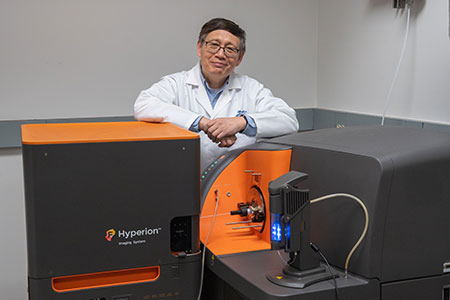
The team’s research shows mice lacking the enzyme histone deacetylase (HDAC3) do not develop Langerhans cells, a type of dendritic cell that normally helps regulate the immune system and can affect multiple organs.
"Langerhans cell histiocytosis is a rare but serious immune disorder,” notes Dr. Mi. “By targeting HDAC3, we’re developing a selective therapy that reduces abnormal LCH cell proliferation without broadly suppressing the immune system."
The team used this knowledge to develop a drug repurposing strategy: leveraging an FDA-approved pan-HDAC inhibitor already used in cutaneous T-cell lymphoma (CTCL) to treat LCH. This de-risked approach accelerates the path to patients by leveraging an established safety profile. Preclinical studies are funded by a U.S. Department of Defense grant, and the team is advancing toward a clinical trial with hematologist/oncologist Philip Kuriakose, MD, supported by the Henry Ford Cancer Institute
Enhancing immunotherapy with less risk of immune system suppression
"In our latest work, we’re studying how immune cells can be reprogrammed to respond more effectively to tumors,” says Dr. Mi. “This approach has broad applications in both cancer immunotherapy and autoimmune therapy by precisely modulating overactive or suppressed immune responses."
Many patients with autoimmune diseases or cancer struggle because current therapies either don’t work well enough or suppress the immune system too broadly, causing serious side effects. This technology offers a novel way to reprogram immune responses by targeting a protein (VPS72), a newly discovered master control switch inside immune cells that governs how genes are turned on or off, that enhances anti-tumor immunity or suppresses autoimmune overreaction.
This technology provides peptides and RNA tools that target VPS72, resetting immune responses to the right level. Blocking VPS72 in regulatory T cells (Tregs) — immune cells that normally keep other immune cells in check — dramatically calms Tregs and shrinks tumors by unleashing the body’s own cancer-killing machinery. On the other hand, increasing VPS72 in Tregs can control autoimmune disease, such as lupus and multiple sclerosis, offering a smarter alternative to today’s broad immunosuppressants.
The team is exploring ways to deliver the VPS72 inhibitor locally to avoid systemic autoimmunity.
Bringing theories from the lab to the bedside
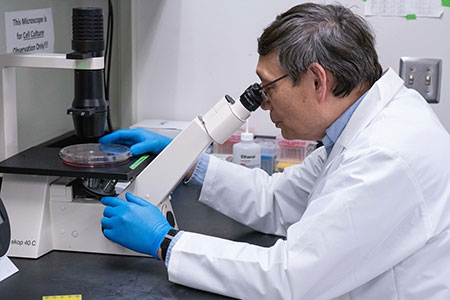
Dr. Mi is a leader in translational science with more than 30 years focused on immunology. His lab comprises 15 researchers as well as medical students and collaborates across multiple countries and institutions with a strong track record of moving technologies from the bench into clinical trials. His lab has been recognized with Henry Ford Health’s Best Publication Awards in both the basic research and clinical research categories over the past five years.
In addition to Director, Center for Cutaneous Biology and Immunology, his list of impressive titles includes Professor, Henry W. Lim Endowed Chair in Dermatology Research and Vice Chair for Research, Henry Ford Department of Dermatology and Director, Immunology Program/Henry Ford Cancer Institute. His dual appointment through the Henry Ford Health + Michigan State University Health Sciences partnership further strengthens the translational infrastructure supporting each of these innovations.
For Dr. Mi, it’s about making discoveries in immunology to improve precision medicine and better treat immune-related diseases and cancer.
“Translational research is how we move what we do in the lab, at the bench, and into humans to treat disease,” he said.
Looking to the future
Dr. Mi is optimistic about what the future holds and is actively seeking licensing partners or co-development sponsors and industry collaborators to advance their patent portfolio into clinical and commercial reality. Looking ahead, he and his team plan to expand its world-class biobank and international patient cohorts, forge new partnerships and collaborative models with industry, and scale AI-driven drug discovery and precision medicine platforms that leverage its deep immunological datasets.