.svg?iar=0&hash=F6049510E33E4E6D8196C26CCC0A64A4)

/hfh-logo-main--white.svg?iar=0&hash=ED491CBFADFB7670FAE94559C98D7798)
Related News




Dr. Rana Awdish Advancing Doctor-Patient Conversations for Henry Ford Health
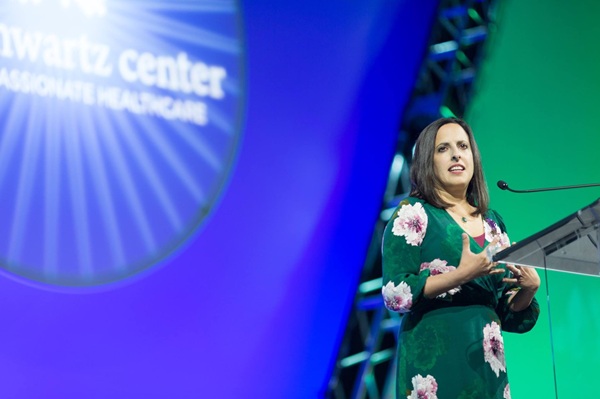
Dr. Rana Awdish wasn’t just content to allow her near-death experience to change her own practice. She wanted it to fundamentally change how medicine was practiced.
In the years since she first became critically ill, she’s worked to make health care more compassionate for patients and providers alike.
In addition to her 2017 landmark medical memoir, “In Shock,” she is the co-author of two recent papers for the Proceedings of the Mayo Clinic that provide a blueprint for a values-based approach to communication.
At Henry Ford Health, where Dr. Awdish is Medical Director of Care Experience as well as Director of the Pulmonary Hypertension Program, she leads small-group experiential learning sessions that use role play with improvisational actors to help physicians deliver more empathetic care. It’s her way of ensuring that what she experienced as a patient doesn’t happen to others.
“Health care is a highly emotional industry, and patients and families are primed to attune to every word,” Dr. Awdish said. “When we are more intentional with our communication, it empowers patients and fosters connection in a way that is truly healing.”
Dr. Awdish’s second book, “After Shock,” is due out in June.
Harrowing ordeal for Dr. Awdish
In the final days of her pulmonary and critical care fellowship, while seven months pregnant, a benign liver tumor ruptured, sending Dr. Awdish into multisystem organ failure. She lost her baby and turned into a patient in her own ICU.
Dr. Awdish’s life was saved repeatedly, leaving her in awe of what medicine could achieve and troubled by what it could not. She was shocked by the language they used to describe her, overhearing phrases like “she’s circling the drain” and she’s “trying to die on me.”
Dr. Awdish had heard these phrases before, recognizing them as part of the culture of medicine.
Her difficult recovery, with multiple surgeries and countless ICU admissions, gave her new insight into the patient experience. That transformation — from critical care physician to critically-ill patient — became a valuable mirror, informing the kind of care she hoped to provide, if she healed enough to return to work.
As Dr. Awdish later wrote in her book, “Medicine cannot heal in a vacuum, it requires connection.”
She returned to clinical practice with a clear mission: To intentionally refocus on humility, relationship-based care, and listening differently, so that each patient feels valued and heard.
Listening as a value
Dr. Awdish’s latest article, published in Mayo Clinic Proceedings, argues that listening is not simply a skill but a value that should shape the culture of care.
She and her co-authors outlined strategies such as proximate listening — being fully present — and listening that fosters resilience — helping clinicians build capacity by connecting authentically.
“Values-based listening reflects kindness, and no service requires kindness more than health care service,” the paper contends. Listening, they state, strengthens trust and improves decisions for both patients and providers.
The paper pushes institutions to move beyond surface-level empathy and embed listening into leadership, workflows, and even structural design. Doing so, the authors argue, reduces burnout and fosters trust in ways technology or efficiency metrics never could.
Henry Ford Health’s pilot program with Microsoft’s DAX Copilot is cited as a program to enable physicians to take more time listening to earn and enable trust.
‘Never Words’ can be harmful
A year earlier in the same journal, in October 2024, Dr. Awdish published another widely read study on “Never words” — phrases so harmful they should never appear in clinical conversations.
Examples include “There’s nothing else we can do” or even the terms “fight” or “battle” — words that may feel routine to clinicians but can be taken poorly by patients and families.
The authors warned: “Never words are conversation stoppers. They seize power from the very patients whose own voices are essential to making optimal decisions about their medical care.”
Instead, the paper offers alternatives such as “We will face this difficult disease together,” which conveys honesty while keeping patients engaged.
Avoiding “Never Words” allows clinicians to preserve agency for patients, leaving room for uncertainty and inviting true partnership in decision-making. For Dr. Awdish, it is another way language can either wound or heal.
For both recent articles, Dr. Awdish worked with frequent collaborator Leonard Berry, who joined Henry Ford Health this summer as a senior quality advisor after more than 40 years on the faculty of Texas A&M University’s Mays Business School. He was attracted to Henry Ford Health in part to work more closely with Dr. Awdish.
“And how fortunate I am because, No. 1, she’s brilliant, and No. 2, she is as beautiful a writer as I’ve ever worked with, ever,” Berry said. “And No. 3, she’s a fantastic person. And we so enjoy working with each other and learning from each other.
“The kind of writing we strive to do together is writing that is scientifically grounded but also meant to be practical and useable.”
CLEAR Conversations set standard
Long before these publications, Dr. Awdish worked with Palliative Care colleagues such as Dr. Kristen Chasteen to build the CLEAR Conversations program for Henry Ford Health in 2012. The program — short for Connect, Listen, Empathize, Align, Respect — has become a cornerstone of clinician training and a foundational piece of the institutional curriculum.
Through role-play with professional actors, observation and feedback, participants learn to navigate the hardest conversations in medicine: breaking bad news, responding to grief, aligning treatment goals. Residents, fellows and faculty alike have passed through the program, making communication training part of the system’s DNA.
Participants take part in a pair of half-day sessions to train on clear and compassionate communication.
“Some of them are so new they have never seen a conversation like this,” said actress Connie Cowper, who has been role-playing in the program since its inception in 2012.
“Common errors are talking too fast and not allowing me — as the patient or family advocate — to express myself. They just want to get in there, share the news and make a plan or whatever.”
But what began as an experiment has become culture change. CLEAR Conversations has been credited with improving patient trust, reducing clinician burnout and setting new expectations for how medical teams communicate.
“I really feel like they come in with an open heart and an open mind,” Cowper said. “My husband and I have already experienced it firsthand during his cancer care (at Henry Ford Cancer - Detroit).”
As Dr. Awdish’s latest studies show, CLEAR Conversations is not just a workshop but a proving ground for a broader vision: transforming medicine one conversation at a time.
###
MEDIA CONTACT: mediarelations@hfhs.org