.svg?iar=0&hash=F6049510E33E4E6D8196C26CCC0A64A4)
/hfh-logo-main--white.svg?iar=0&hash=ED491CBFADFB7670FAE94559C98D7798)
Innovator Spotlight: Avi Cohen, MD
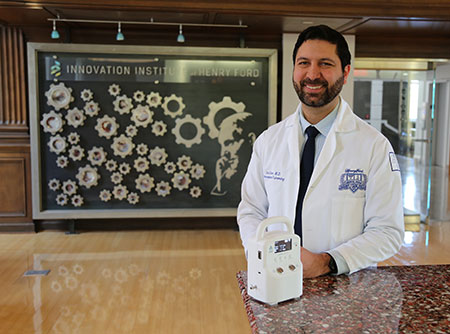
Understanding how technology can lead to better care, better outcomes
Avi Cohen, MD, has always liked a puzzle. He leverages that love of problem solving each day as he cares for patients and embarks on new paths to detect, treat and manage lung disease.
Dr. Cohen is the Director of Interventional Pulmonology at Henry Ford Hospital and Director of the Lung Cancer Screening Program across Henry Ford Health. During residency, the fairly new specialty of Interventional Pulmonology lured him away from internal medicine with its additional reliance on technology and the promise to be in on the ground floor of yet-to-be discovered treatments and therapies
“And after I did internal medicine, I ran into critical care,” he said. “And I really loved it. I thought ‘this is what I was looking for’ and so I did a critical care fellowship.”
Critical care medicine is combined with pulmonary medicine. Critical care is the driver, pulmonary the passenger, he said.
“I started doing pulmonary and critical care, and during my rotation, I ran into interventional pulmonology, which was using technology and procedures to get things to where they need to be. Being a video gamer and enjoying computer science and technology, this was my calling.
I looked at it and said, this is perfect. I’m using technology every day. I'm holding a camera, I'm working with robots. And so critical care was the driver initially, but I exited the vehicle exactly where I was supposed to be, which was with interventional pulmonology, which is where technology comes in.”
Currently, his penchant for innovation is helping move forward three technologies that have the potential to improve care for a wide range of patients. All involve the idea that when it comes to patient care more information is usually better and that collaboration with industry, particularly start-ups, really can move the needle.
Optellum: Using AI to find lung cancer earlier
Collaboration with colleague and mentor Michael Simoff, MD during his fellowship helped point Dr. Cohen in the direction of research and innovation.
“My passion for technology was there, and he took me under his wing and mentored me with a lot of the projects that he was working on, different types of forceps, different types of imaging, bronchoscopically and such, and different artificial intelligence algorithms for lung cancer screening. So as I gained that mentorship from him, we took on a few projects. Optellum was one of them.”
Optellum’s virtual nodule clinic (VNC) is an early lung cancer diagnosis solution that uses the FDA-approved technology to discover, track and assess the risk of malignancy in lung nodule patients. Along with Dr. Simoff, Dr. Cohen was involved in research collecting data to train Optellum Lung Cancer Prediction® (LCP) AI.
Now, Dr. Cohen is working to bring Optellum to Henry Ford. He sees the technology as a game changer for catching lung cancer when it is most treatable. The Optellum database works in tandem with radiologists and ups the game by providing longitudinal monitoring of patients instead of a snapshot in time.
He presented this scenario: “A patient comes into the ER and has a CT scan done for some reason or another. The CT scan detects a nodule. Optellum is aware of this nodule now. It picks up this report that the radiologist has completed and it puts it into a queue. In that queue, we run an analysis on that nodule using the AI software that determines the risk of this being a malignancy using a score of 1 to 10.
It also puts them into a platform that monitors the patient as they move through the health system. So if they have another CT scan in three months somewhere else, it can compare those two now and decide whether this is growing, this is concerning. It’s one more important piece of information to help us determine what pathway the patient should take.”
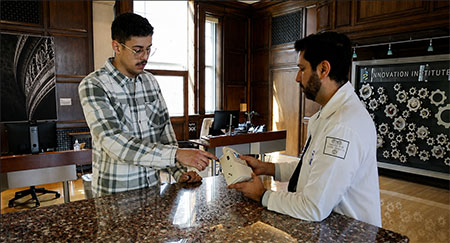
Advanced Interactive Response Systems (AIRS): The next level for oxygen therapy
Oxygen therapy is central to managing chronic obstructive pulmonary disease (COPD). Current systems are prone to hidden failures such as disconnections, leaks, depleted tanks and improper oxygen titration.
Patients may receive too little or too much oxygen, both of which carry serious risks. Clinicians, meanwhile, often lack real-time insights, relying on intermittent spot checks that can miss critical changes.
AIRS provides smarter, safer, and more proactive monitoring that improve both patient health and caregiver efficiency using its oxygen flow monitor (OFM), the first device to continuously track both the patient and their oxygen supply.
Dr. Cohen was connected with AIRS after its founder completed the inaugural Conquer Detroit Healthcare Accelerator in 2024. Coming full circle, he worked with then pulmonary fellow Dr. Alexndra Gastesi to design a clinical feasibility study now underway at Henry Ford’s Pulmonary Rehabilitation Center:
“I took Alex under my wing and we worked together to really get AIRS to where it needs to be and where we can get it to its fullest potential,” he said.
The study compares AIRS’ continuous monitoring against current standard-of-care intermittent checks.
The goal is to evaluate whether the OFM provides measurable benefits in patient safety, workflow efficiency and rehab outcomes. Clinicians are integrating them into real-world rehab workflows.
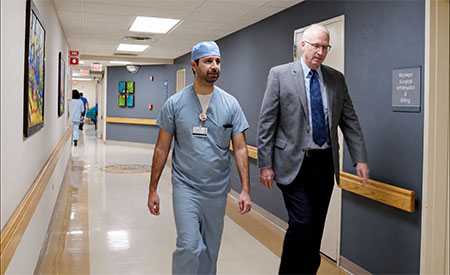
Cura Collaborative: Simplifying among patients, caregivers and clinicians
Another pilot Dr. Cohen is leading involves Care Bridge, a patient and family engagement application developed by start-up Cura Collaborative that works alongside existing electronic health record systems. Through task-based guidance and mobile access, caregivers receive clear, timely instructions that help patients prepare for visits, tests and treatments before they arrive at the hospital. For clinical teams, the platform offers real time visibility into patient readiness, helping reduce missed steps, confusion and avoidable delays in care.
Many of Dr. Cohen’s patients face complex diagnoses and treatment plans. Managing complex medical care can be overwhelming for patients and the family members who support them. Care Bridge replaces static, manual coordination tools with a shared digital experience for staff, patients and caregivers. This patient-centered innovation brings clinicians, families and technology partners together to improve care both inside and beyond the hospital.
A bright future ahead
While some may be skeptical about what’s coming in the age of AI and health care, Dr. Cohen sees possibilities.
“I'm really interested to see where things go, and I'm really interested and excited to be part of it,” he said. “I imagine that one day, the bandwidth that we have for patient care is going to increase tremendously because these automated processes that we do without thinking twice will be taken over by artificial intelligence. And so that'll give us more capacity to continue innovating and continue providing the services that we can as best as we can.
Just like the internet changed our social lives and our clinical lives and careers and everything in terms of communication, I think AI is that next evolution in innovation and I want to be a big part of it.”