


Back in the Race: Partial Knee Replacement Restores
After knee pain threatened the activities that supported his physical and mental health, Tim found hope in a second opinion.
"Dr. DeClaire gave me hope. He believed in me, and if he believed in me, I believed in him."
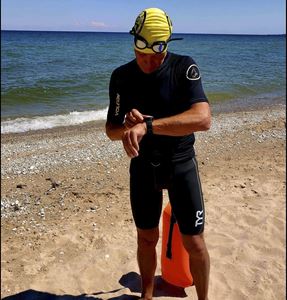
For Tim Seagram, movement has always meant more than staying fit. The Rochester Hills resident has spent decades running marathons and competing in Ironman events. After retiring from a 47-year career, he became an on-call volunteer firefighter. Running, swimming and cycling also play an important role in supporting his mental health.
So when worsening pain in his right knee began taking those things away, Tim felt as though he was losing part of himself.
"I was a long-distance runner who was used to doing 20-plus miles," Tim says. "I got to the point where I could not run one mile."
Tim managed the pain for about a year, continuing to race without telling others how badly he was hurting. Eventually, even climbing the stairs became difficult. Imaging showed that the meniscus in his knee was essentially gone and arthritis had severely damaged the joint. His doctor told him the knee would not heal on its own and recommended that he consult a surgeon.
A second opinion focused on Tim's goals
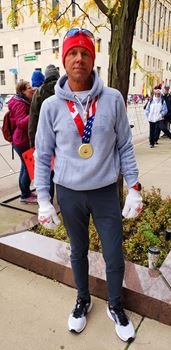
The first surgeon Tim met recommended knee replacement but told him that running and triathlons would no longer be possible. Although Tim believed the surgeon was highly skilled, he left the appointment discouraged and decided not to proceed.
"Running was my life," he says. "If I could not run, I thought I would just have to live with the pain."
A few weeks later, Tim's wife asked him to get a second opinion from Jeffrey H. DeClaire, M.D., chief of orthopedic surgery at Henry Ford Rochester Hospital. At their first visit, Dr. DeClaire pulled up
Tim's X-ray images, explained the difference between partial and total knee replacement, and examined how his knee moved. He believed Tim was a strong candidate for a partial knee replacement and took time to understand the activities Tim hoped to resume.
"He was very humble," Tim says. "He never talked about himself. He just said, 'We are going to get you back on track.' He believed in me, and if he believed in me, I believed in him."
For the first time since learning he needed surgery, Tim could imagine an active future again. He chose to move forward with a partial replacement of his right knee.
A plan - and a team - for every step
On the morning of Tim's Feb. 4 surgery, Dr. DeClaire greeted him with the same optimism that had built his confidence from the beginning.
"He came to my bedside and said, 'Are we ready? This is a good morning for surgery,'" Tim recalls. "He was so positive that any anxiety I had was gone."
Dr. DeClaire encouraged Tim to begin walking after the anesthesia wore off and showed him three exercises to start right away. At home, Tim used an ice therapy machine, performed the prescribed exercises and committed himself to physical therapy. Within two weeks, he was driving himself to rehabilitation appointments.
Tim also felt supported between visits. For the first two months, the care team checked his pain level, range of motion and exercise progress through the patient app. When Tim noticed redness near his incision and sent a message, team member Amanda responded within minutes and arranged for him to be seen the next morning. Meredith assured him that the team would continue monitoring his recovery and answering questions for a full year.
"They never made me feel like I was bothering them," Tim says. "Whatever question I had, they were there. They took the anxiety out of the entire process."
Dr. DeClaire had warned Tim that his biggest challenge might be trying to do too much too soon. That warning stayed with Tim as he worked through each stage of the recovery plan.
"They did all the legwork and all the hard work," he says. "I just did what they told me to do."
Tim is now preparing for an Olympic-distance triathlon at Stony Creek Metropark in September. He also plans to complete a marathon alongside his wife and is registered for IRONMAN 70.3 Hawai'i in June 2027.
Back to training - and looking toward Hawaii
By the time of his interview about six months after surgery, Tim was once again swimming, cycling and running. He reported no pain, swelling or stiffness in the replaced knee - an outcome that surprised even the trainers helping him prepare for his next events.
"At one point, I thought I was not going to do anything - I just wanted to walk," he says. "Now I have the chance to get back to racing again. I never thought I would be here this soon."
Tim hopes his experience encourages others not to assume that treatment automatically means giving up the life they love. He believes it is important to find a physician who listens to what matters to the patient - and to seek another opinion when the first path does not feel right.
"If you are in pain and there are things you enjoy - whether that is pickleball, traveling or something else - do not live with the pain," Tim says. "Go see someone and get a second opinion. It paid off for me."
He credits his wife for helping him find the right care, his rehabilitation team for supporting his recovery, and Dr. DeClaire and the entire Henry Ford team for giving him back something he feared he had lost.
"I am grateful that I can exercise, go to the firehouse, train again and have the chance to race again," Tim says. "Dr. DeClaire changed my life. He gave me hope."
Get the Care You Need
Do not let knee pain keep you on the sidelines. Learn more about orthopedic care at Henry Ford Health.