.svg?iar=0&hash=F6049510E33E4E6D8196C26CCC0A64A4)

/hfh-logo-main--white.svg?iar=0&hash=ED491CBFADFB7670FAE94559C98D7798)
Still Kickin
For Mark Phillips, Saturday mornings consist of a pick-up game of soccer with friends and breakfast at a local diner. One morning in June, his routine was interrupted. While enjoying a post-game birthday breakfast, Mark began feeling lightheaded and “off.”
“I got up and went outside to get some fresh air, thinking maybe I could shake the feeling,” says Mark. “When I returned to the table, my speech had begun to slur and my tongue felt like it was swelling inside my mouth.”
Fast action from family, friends and the Henry Ford Stroke Team helped save Mark’s life.
Not sure whether Mark was having an allergic reaction or something else was going on, his wife, Tracy, along with his friends Sam and Luke, sprang into action and looked up the nearest emergency room on their phones. There were a few options available, but Tracy decided, “We’re going to Henry Ford — that’s where I’m comfortable going.”
“I don’t normally attend breakfast with him, but since it was his birthday, I figured I would surprise him,” says Tracy. “I’m glad I did, and I’m glad we came to Henry Ford.”
Upon arriving at Henry Ford West Bloomfield Hospital Emergency Room, the medical team evaluated Mark using the National Institutes of Health Stroke Scale to determine the severity of his stroke. Initial results placed him at a one on the scale, but that quickly changed as he developed elevated blood pressure and eventually left-side paralysis. Dr. Justin Kessler, an emergency medicine physician, contacted the Henry Ford Stroke Team, and the teams began working together to determine the best care plan for Mark.
Teamwork to save Mark’s life
Mark underwent a computed tomography (CT) scan, which provided real-time results showing an ischemic stroke. He had one blockage in his brain and two in his neck. Dr. Kessler administered tissue plasminogen activator (tPA), while the interventional radiology team assembled to retrieve the clots.
“The real hero is Mark’s wife, Tracy. If she had waited even a few more minutes to bring him in, the results could have been significantly different,” says Dr. Kessler. “We were within the appropriate window to administer tPA and allow our interventional team to remove the remaining clot. The cross-team collaboration not only saved his life but allowed for minimal residual effects from his stroke.”
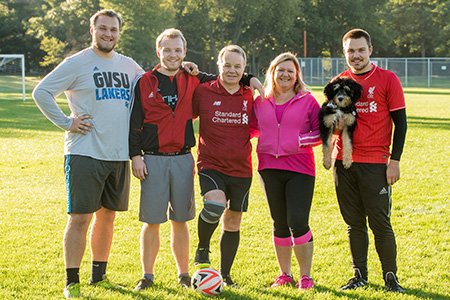
The response to tPA was almost immediate. Mark regained consciousness and gave a thumbs-up to his family before being transported to the procedure room. “We told him that France had beaten Argentina in the FIFA World Cup playoffs, and he gave us a thumbs-up. That’s when I knew he was going to be alright,” says Tracy.
The interventional radiology team, led by Dr. Max Kole, performed a thrombectomy — a procedure to remove a blood clot from a blood vessel.
Returning to the field
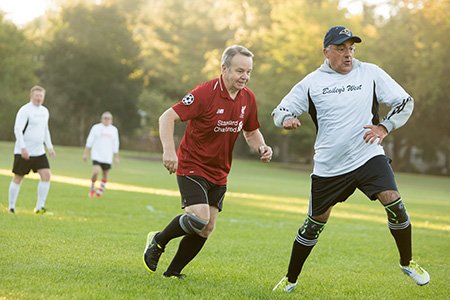
Five weeks after his stroke, Mark returned to his Saturday routine — a pick-up game of soccer with his friends and breakfast at his favorite diner. “My goal was to get back on the soccer field, and I was able to do that without the need for occupational, physical or speech therapy,” says Mark. “I can get back to life again, thanks to the team at Henry Ford.”