


After Colon Cancer Diagnosis, Linda Finds Expert Care — and Comfort from an Unexpected Furry Friend
For many people, Y2K brought uncertainty about what the new millennium would bring. For Linda Waynick, January 2000 marked the beginning of a series of health challenges after she suffered an electric shock at work.
The injury left her on disability and dealing with several health issues, including non-diabetic neuropathy in her lower extremities and right arm and hand, severe headaches and swelling on the right side of her face.
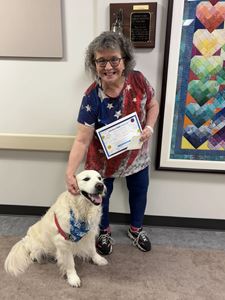
Some of the activities Linda once enjoyed, including baking, were put on hold because of her injury. But she never lost her sense of humor.
“People always told me I was hot headed and had an electric personality but this is a bit overkill,” she quips.
Despite her health challenges, Linda found purpose and joy in giving back to others. For more than a decade, she and her husband have provided DJ entertainment services for veterans and others in their community through Stars and Stripes Forever.
“We’ve been doing this for more than a decade and it brings us great joy.”
Unexplained fatigue leads to a colon cancer diagnosis
In January 2025, Linda began experiencing unusual fatigue. Concerned that something wasn't right, she made an appointment with her Henry Ford Macomb Hospital primary care physician, Mohammadreza Kahnamouei, M.D..
“Dr. Kahnamouei ordered tests and discovered my hemoglobin was low,” she recalls.
When Linda's hemoglobin remained low despite iron infusions, she was referred to Dr. Gurpreet Singh, who ordered a colonoscopy.
The procedure revealed a tumor approximately the size of a baseball. A biopsy confirmed that Linda had colorectal cancer.
The diagnosis was difficult to absorb, but Linda quickly moved forward with treatment. In August 2025, she underwent surgery with Dr. Akash Sheth to remove the tumor and surrounding lymph nodes.
Dr. Sheth explains Linda underwent a robotic, minimally invasive surgery to remove the tumor and the surrounding lymph nodes, to help stage the cancer. “Linda did extremely well after the surgery and went home two days later. Unfortunately, one of the lymph nodes did have metastatic disease, confirming the presence of stage 3 cancer.”
Following surgery, Linda underwent chemotherapy and immunotherapy under the care of Henry Ford oncologist Dr. Aula Ramo. The treatments aim to eliminate any remaining cancer cells and reduce her risk of recurrence. Linda says she is thankful the treatments have been completed and is slowly but surely getting her energy back.
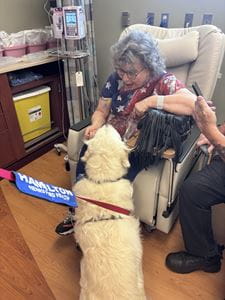
A furry friend brings comfort during treatment
Throughout her cancer journey, Linda says she felt grateful for the care and support she received from her Henry Ford Macomb team.
“All of my doctors and providers at Henry Ford Macomb have been great! They are the best in my book,” she says.
But one unexpected member of her care team also made a lasting impression: Hamilton, a therapy dog who Linda met during her first chemotherapy treatment.
Linda, who has a dog and a cat of her own, says she immediately connected with Hamilton and his owner, Cheryl Kahl.
“I had no idea they had therapy dogs at Henry Ford Macomb but I met Hamilton and his owner Cheryl Kahl during my first chemotherapy treatment and instantly made two great friends who provided comfort and happiness during my treatment,” she says.
The bond quickly grew. Linda began bringing Hamilton dog treats and homemade dog food during her visits to the cancer center.
“A+ to Henry Ford Health for offering this special service. Hamilton lights up the patients’ world when they are in the cancer center and makes the treatment situation easier,” Linda says.
For Linda, Hamilton and Cheryl provided something beyond her medical treatment: emotional support during a difficult time.
“Medicine is a cure, but emotionally Hamilton and Cheryl were my emotional support,” she emphasizes.
Linda encourages others to listen to their bodies
After everything she has experienced, Linda has a simple message for others: Don't ignore changes in your health.
With colorectal cancer becoming increasingly common among younger adults, she encourages people to pay attention to symptoms such as unexplained fatigue and to talk with their health care provider about colorectal cancer screening.
“When your body tells you there’s something wrong, you’re feeling fatigued and not yourself, get yourself a colorectal screening,” she emphasizes. “Even if the diagnosis is cancer, it is not necessarily a death sentence anymore due to the advanced medical technology and treatment.”
Linda credits her Henry Ford care team with listening to her concerns, identifying the cause of her symptoms and treating her cancer.
“I wouldn’t be here if my doctors were not top notch and on top of the situation, and they were able to get it at a stage that, good Lord willing, I won’t ever see it reoccur, because then I’ll have to turn around and kick its butt again.”
For further information, visit Colorectal Cancer Care at Henry Ford Health.