.svg?iar=0&hash=F6049510E33E4E6D8196C26CCC0A64A4)

/hfh-logo-main--white.svg?iar=0&hash=ED491CBFADFB7670FAE94559C98D7798)
Benefits of Thyroid RFA
Did you know there is a non-surgical option for the removal of thyroid nodules? Learn about Thyroid Radiofrequency Ablation.

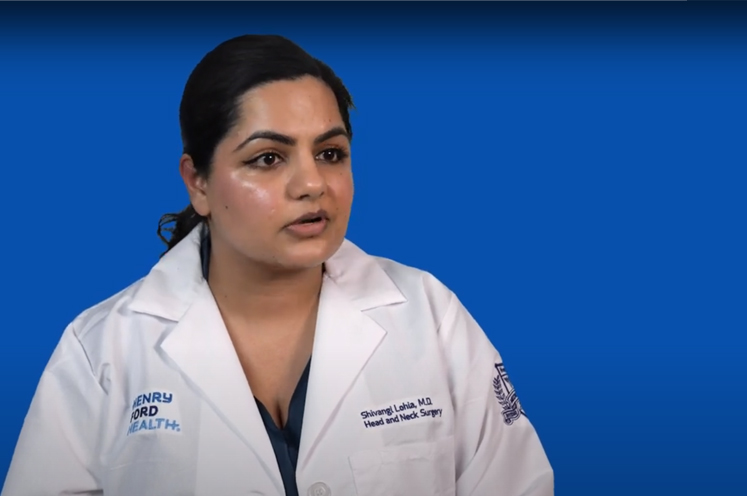
Radiofrequency ablation (RFA) is an innovative nonsurgical option to treat thyroid growths (nodules). At Henry Ford Health, this approach offers excellent results with fewer side effects and a lower risk of complications.
Historically, surgery was the only option to treat thyroid nodules. Surgery is effective, but it comes with risks and leaves a scar. Now, Henry Ford Health offers RFA, a highly effective nonsurgical option.
The Henry Ford Health difference:

All treatments and procedures have risks and these will be discussed in detail with you by your doctor.
RFA shrinks thyroid growths while preserving healthy thyroid tissue. It’s an outpatient procedure, which means you return home the same day with minimal downtime. Other benefits of RFA include:
RFA is a treatment for thyroid nodules. Thyroid nodules are solid or fluid-filled lumps that develop on the thyroid gland, a hormone-producing gland at the front of your neck. Sometimes, thyroid nodules are cancerous, but usually they’re not (benign).
Even when thyroid nodules are benign, they can still cause problems such as:
RFA is a minimally invasive treatment that uses controlled heat to shrink and destroy thyroid nodules. It can be an effective alternative to surgery for some patients. The procedure is quick and painless, and you can resume your usual activities right away.
On the day of your RFA procedure, you come to the clinic. You lie on your back with your head on a cushion and your neck extended. Then, your thyroid surgeon:
1. Gives local anesthesia around your thyroid so you don’t feel anything during the procedure
2. Inserts a thin needle with an electrode into the thyroid nodule
3. Uses carefully controlled heat that flows through the electrode to destroy the nodule
4. Removes the needle and places a small bandage over the treatment area
You will be able to breathe, swallow and speak normally throughout the procedure. Your doctor will ask how you’re doing and can make adjustments if you’re uncomfortable.
RFA is generally a short procedure. The exact time can vary based on the size and location of the nodule. Generally, you can expect RFA to last between 15 to 60 minutes.
RFA treats benign thyroid nodules that are causing discomfort, swelling or other symptoms. It’s not appropriate for people who are pregnant or have cardiac pacemakers.
Surgeons may use local anesthesia to numb the area around your thyroid. You may feel some pressure, but you won’t feel pain or heat during the ablation.
RFA is a low-risk procedure, and most people don’t have side effects. Rarely, it can cause some mild symptoms such as temporary voice changes, bruising or infection. It can also cause changes in thyroid hormone levels, which are usually temporary.
After RFA, your immune system breaks down the nodule and removes it as waste. Most people notice that their nodules shrink significantly within two to three weeks.
Two convenient locations are available for your thyroid RFA treatment, with an initial in person assessment at Henry Ford Medical Center - Templin and the actual procedure being performed at our Henry Ford Cancer Pavilion.
We use cookies to improve your website experience. By using this site, you agree to our Terms of Use. Read our Internet Privacy Statement to learn what information we collect and how we use it.