.svg?iar=0&hash=F6049510E33E4E6D8196C26CCC0A64A4)

/hfh-logo-main--white.svg?iar=0&hash=ED491CBFADFB7670FAE94559C98D7798)
Comprehensive Diabetic Foot Care Helps Retired Teacher Avoid Amputation
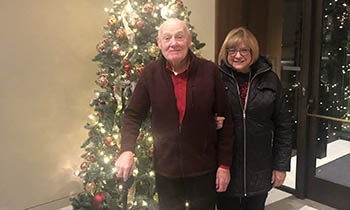
After more than 50 years of marriage to her husband, Giles, and a career dedicated to teaching, Jackie Wilborn envisioned retirement as a time to slow down and savor life. With two children and the joy of soon becoming a grandmother of four, the Grosse Pointe Woods resident filled her days with travel, family time, and meaningful work in her community.
“After retiring from teaching, I have enjoyed travel, spending time with my family and grandkids, and using my love of history to serve as a docent at the Eleanor and Edsel Ford House,” Jackie says. Her passion for books and learning also led her to a part-time job as a clerk at the Harper Woods Library.
That active retirement, however, was suddenly threatened by a serious complication of diabetes.
When diabetic foot disease threatens independence
In 2024, Jackie, who has type 2 diabetes, developed an ulcer on her right foot that would not heal. She also developed a deformity that forced her foot to turn inward. “Unfortunately, I had to quit my job at the library and start exploring treatment options because of everything that was happening with my foot,” she explains. Jackie was diagnosed with Charcot foot, a severe and potentially limb-threatening complication of diabetes that weakens the bones and joints in the foot. As the condition progresses, bones can fracture and collapse, dramatically increasing the risk of infection and amputation.
After seeing a local podiatrist without improvement, Jackie sought another opinion—only to receive devastating news. “He saw me for just a few minutes and told me my right foot would need to be amputated,” she recalls. “I wasn’t satisfied with that answer.” Determined to explore every option, Jackie turned to her primary care physician at Henry Ford Health.
Finding better solutions at Henry Ford Health
Her family medicine doctor Mariya Kopyrina, M.D., referred her to Andrew Mastay, D.P.M, podiatric surgeon at Henry Ford Health. After a comprehensive evaluation, Dr. Mastay delivered the news Jackie had been hoping for. “He said, ‘I can fix this,’” she happily recalls.
Saving her foot through reconstruction
Dr. Mastay explains that below-the-knee amputation is often considered for patients with advanced diabetic foot disease. In Jackie’s case, however, he was able to offer a limb-salvage approach through a major reconstruction of her foot and ankle—an option that would preserve her foot and restore function.
“Her Charcot foot had advanced to the point she was walking on the outside of her foot and was developing ulcerations which extended almost to bone, putting her at risk of osteomyelitis (infection in the bone),” he notes.
Before reconstruction Jackie had multiple bone biopsies to confirm the lack of infection in her bone. Once that was confirmed, she underwent reconstructive surgery where her talus was removed and the foot was realigned under her leg while a skin flap was performed to close her open ankle ulceration.
“It was very important she maintain her HbA1c and glucose levels during the entire process as it can have a major impact on healing,” Dr. Mastay expresses. “Because of her previously uncontrolled diabetes, she did not heal as expected and used a bone stimulator to obtain healing.”
He adds that Jackie was resilient throughout the entire process and in the end has a plantigrade foot where the entire sole of the foot—from the toes to the heel—touches the ground with every step.
“While it was not an easy road, she kept a positive attitude and avoided a below knee amputation.”
The road back to independence
Jackie describes the reconstruction process involving multiple surgeries and extensive rehabilitation as challenging, but ultimately life changing.
“This is not for the faint of heart,” she says.
As a result of the surgery, Jackie’s right foot is now slightly shorter than her left. To support her mobility, she will be fitted with an ankle brace and shoe lift designed to help her walk comfortably and safely.
Despite the long recovery, Jackie is already looking ahead.
“I look forward to driving again, enjoying my grandkids, and going to a cottage this summer with boating activities,” she says. “The treatment and recovery took time, but I’m so thankful to Dr. Mastay, the Wound Care Clinic, and the entire Henry Ford team. They were all fantastic. It was well worth it to get my independence back.”