


Like Family
When 11-year-old Easton woke up at night with intense abdominal pain, his family thought it was his appendix.
“They said it could be a blockage in my bowel,” says Easton, now 15. “They mentioned Crohn’s disease but said it was unlikely that’s what it was.”
Trish was adamant about not leaving the hospital without a plan. She worked with the pediatric gastroenterology (GI) care team to get a colonoscopy scheduled, but they couldn’t get Easton in until the following month.
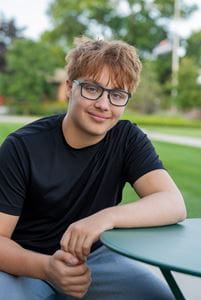
“After the scope, the doctor took us into the room and told us Easton had Crohn’s,” Trish says.
Crohn’s disease is one of the major forms of inflammatory bowel disease (IBD). This chronic inflammation of the GI tract most often causes abdominal pain and severe diarrhea, but it can also lead to malnutrition and life-threatening complications.
The hospital team admitted Easton and gave him an infusion of Remicade – a targeted biologic medication that’s used to treat inflammation. Then sent him home. But this wouldn’t be Easton’s last hospital trip.
“His pain kept coming back, and it didn’t seem like the care team was doing much about it,” Trish says. “We’d had enough and started looking around for a second opinion.”
A fresh start
Ultimately, they met with Seth Iskowitz, M.D., who at the time was in his pediatric gastroenterology fellowship at another health system. They noticed the difference immediately.
“He made me feel calm,” Easton says. “He didn’t overwhelm me with questions and took time to ask me about my personal life.”
Dr. Iskowitz also made sure the family understood Easton’s diagnosis fully.
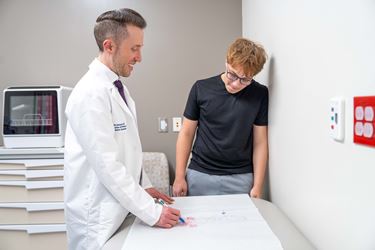
“He walked over to the bed that had the paper with Easton’s case notes,” Trish says. “He told us, ‘I know some people understand things better in pictures,’ then he drew everything out on the paper and explained it to us in layman’s terms so we could understand fully what was happening. I couldn’t believe that after dealing with this for months, he made us feel better in five minutes.”
Dr. Iskowitz also reviewed Easton’s current infusion treatment and expanded it, personalizing the care plan for Easton’s needs – including adding some medication for his pain.
Trials and transitions
While Easton and his family were happy to have a plan, the hopeful feeling didn’t last.
At school, Easton faced severe bullying due to his Crohn’s disease. Worse, he didn’t receive much support from the school administration. It got so bad that Easton wouldn’t use the school bathroom and started holding it. This caused his colon to expand to the point where even after using the bathroom it wouldn’t return to a normal size. This would ultimately cause chronic constipation, something that Easton still suffers from today.
“I’m a principal myself, so school has always been number one in our lives,” Trish says. “We pulled him out of that school.”
After this experience, Dr. Iskowitz recommended pain-reprocessing therapy, which helps retrain the brain to interpret and respond to bodily signals properly.
“We did that for a few years, and it helped tremendously,” Trish says.
But during this time, Easton’s family faced another dilemma. Dr. Iskowitz was finishing up his fellowship. Should they stay with their current health system that was closer to their home and transfer Easton’s care to a new doctor there, or follow Dr. Iskowitz to wherever he went next, even if it wasn’t local?
“At first, we said goodbye to Dr. Iskowitz,” Trish says.
The transition hit Easton particularly hard. Over time, he had gotten close to Dr. Iskowitz, who to him was just “Seth.”
Easton’s family didn’t know that Dr. Iskowitz was now working at Henry Ford Health as a pediatric gastroenterologist. But they tracked him down online and asked if he would take on Easton as a patient again.
“He said he’d love to,” Trish says. “Dr. Iskowitz is everything. The way he talks to Easton, how he takes an interest in his life. Even though it means we need to drive over an hour to Henry Ford Medical Center – Royal Oak for our appointments, it’s worth it.”
Living life on his terms
Easton and Dr. Iskowitz have had many conversations about Easton’s passion: playing baseball as a pitcher and first baseman.
“I have been playing since T-ball,” Easton says. “I just love playing with my friends. I love being on the field. I always look forward to playing no matter how long it's been since I was last on the field.”
When he’s playing, it’s an opportunity to let everything else drop away for a while.
“Baseball is his life,” Trish says. “Easton plays through the pain. He’ll take himself out if it’s too much, but for the most part, he doesn’t let it affect him. When he’s playing baseball, he’s just a normal kid.”
For years, Easton has also attended Camp Oasis, a summer camp sponsored by the Crohn’s and Colitis Foundation that gives kids with inflammatory bowel disease a safe environment to meet others who face the same challenges. The camp helps spark new friendships and build confidence, while giving everyone a chance to participate in fun activities with their peers.
“What I like about camp is that there are people all around – including the counselors – that help you see you aren’t alone with this disease,” Easton says.
Unfortunately, Easton couldn’t attend last year because baseball tryouts were the same week, and the camp typically requires kids to stay the whole week.
“This year, it was the same timing, and we thought Easton would have to miss it again,” Trish says. “But we talked to Dr. Iskowitz, he called the camp and they made an exception so Easton could leave briefly for his baseball tryouts.”
Looking forward
Thanks to his time spent with Dr. Iskowitz, Easton knows everything about his condition, the medications he’s on, why he’s on them, and what he needs to do to get the most out of living with Crohn’s disease. Over the course of his treatment, he’s had several more colonoscopies and other diagnostic procedures, and his Crohn’s disease has moved to different parts of Easton’s bowel.
When a new challenge comes up, his family works closely with Dr. Iskowitz – now the Director of Pediatric Endoscopy at Henry Ford Health ¬– to find a solution.
“Given Easton’s chronic constipation, he has had to have multiple enemas,” Trish says. “At first, we had to do home enemas. It’s horrible to give your child an enema, and it was tough on everyone, including Easton. Dr. Iskowitz found another way. Now he orders periodic colon cleanings as part of his treatment plan.”
Trish describes treatment with Dr. Iskowitz as more of a conversation and a shared decision than a prescription.
“But we trust him and always go with what he thinks is best,” Trish says.
As Easton gets older, he’ll also be eligible for other treatments that could make even more of a difference.
“When he ages out of pediatric care, we will go with whoever Dr. Iskowitz recommends,” Trish says. “He’s like part of our family now. We’re grateful that he sees Easton as a person, not a disease. We’ve also referred other families to him.”
As for Easton? His experience living with Crohn’s and working with Dr. Iskowitz has inspired him to help others in the future.
“The times I didn't have Seth as my doctor I went through some of the worst pain I’d ever felt,” he says. “It was a lot of mental pain, too, because I trusted Seth so much. When I grow up, I want to be a therapist. I want to help kids and adults that have chronic pain find a way through it faster than I did.
Find out more about our pediatric gastroenterology services.