.svg?iar=0&hash=F6049510E33E4E6D8196C26CCC0A64A4)

/hfh-logo-main--white.svg?iar=0&hash=ED491CBFADFB7670FAE94559C98D7798)
Restoring Health and Confidence through Cardiac Rehab
 Bob Akers credits Henry Ford Health with restoring both his physical and emotional quality of life. The longtime Clinton Township resident recalls that he began having heart problems soon after he lost his wife, June. “We met when I was 16, and we were married for 49 years. She was the center of my life,” Bob says. “Losing her was like losing my connection to the outside world.”
Finding answers after loss
Bob first noticed something was wrong when he started feeling a heaviness in his chest while talking for any length of time. Because of his strong family history of congestive heart failure, he made an appointment with cardiologist Theodore Schreiber, M.D., at Henry Ford Warren Hospital.
Discovering Bob’s irregular heartbeat, Dr. Schreiber performed a cardiac catheterization This minimally invasive test checks for possible blockages to the heart. Finding a 90 percent blockage in one of Bob’s arteries, the doctor inserted a small mesh tube, called a stent, to keep the artery open and restore blood flow to the heart. He also recommended that Bob attend Henry Ford Cardiopulmonary Rehabilitation – Warren.
“Joining the rehab program was the best thing that could have happened to me,” Bob says. “The supervised exercise gave me the confidence to rebuild my physical strength. Just as importantly, the professional, genuinely compassionate staff helped me reconnect with the world.”
Building strength one session at a time
Henry Ford Cardiac Rehabilitation is a personalized exercise program aimed at strengthening the heart and body after a serious heart incident. Supervised activity in a safe environment gives participants the confidence they need to gradually grow stronger. The program also helps them maintain their independence and increases their resistance to future heart problems.
Patients typically begin with Phase One rehab while they are still in the hospital. This phase provides moderate physical activity as well as information on nutrition, exercise and other aspects of a healthy recovery.
Since Bob had an outpatient procedure, he began his rehab with Phase Two, which continues heart-health education, combined with heart-monitored, medically supervised exercise. Bob completed the 36-week program, attending twice per week for 46 to 60 minutes. “I enjoyed the exercise and camaraderie so much that I never missed a day,” he says.
Bringing joy to rehabilitation
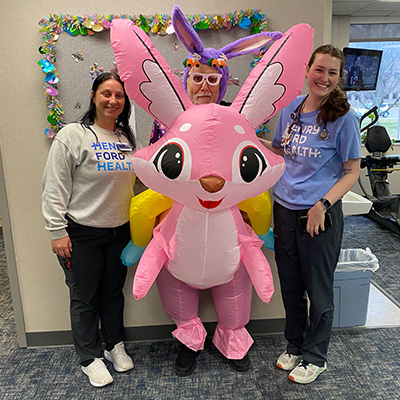 During a session, Bob mentioned that he and June used to love dressing up for Halloween at their RV campgrounds, and he’d collected many costumes over the years. On a friendly dare from a team member, Bob started attending his rehab sessions wearing a different costume for every holiday and special occasion. “Everyone seems to enjoy it, so I try to outdo myself each time,” he says.
After completing Phase Two, Bob moved on to Henry Ford’s PREVENT program, which provides education, supervised exercise and group classes for individuals with all types of chronic illnesses and other health concerns.
Grateful for the care that made a difference
Bob is getting stronger every day and continues with his exercise sessions. He wishes to thank his son, daughter and six grandchildren for their love and support along the way. He is also grateful to Dr. Schreiber and the entire Cardiac Rehabilitation team at Henry Ford Warren Hospital. “They create an environment where you feel at ease, supported and truly cared for. Their encouragement and kindness helped me move forward in my rehabilitation with confidence and comfort,” Bob says. “Their dedication and warmth make all the difference on the journey toward better health.”