.svg?iar=0&hash=F6049510E33E4E6D8196C26CCC0A64A4)

/hfh-logo-main--white.svg?iar=0&hash=ED491CBFADFB7670FAE94559C98D7798)
Successful Foot Surgery and Dramatic Weight Loss Gives Military Veteran a Healthier Lease on Life
Charles Butcher was just 18 years old when he began serving in the U.S. Air Force, a role that took him across the globe for four years.
“I was in the first Gulf War and traveled the entire world serving as a load master on cargo aircraft,” he says. After being honorably discharged in 1992, Charles transitioned to civilian life, building a long career in automotive manufacturing, design, and development testing that spanned more than 20 years.
Outside of that professional work, Charles stayed busy with hands-on projects, building several houses as a former general contractor and restoring and tinkering with cars. These pursuits brought him pride and fulfillment, but throughout his life he continued to battle a persistent health challenge.
A lifelong struggle with weight
“I was always a big kid and fought with my weight my entire life,” Charles says. After leaving the military, his weight continued to climb, a struggle that intensified after he was laid off from his most recent role as a quality manager in December 2024.
“I went into a little bit of depression, became sedentary and morbidly obese,” he explains. As a borderline diabetic, Charles began experiencing serious complications, including pressure ulcers on the bottoms of his feet, significant fluid retention, and swelling in his legs. His condition quickly worsened.
“It was severe on my right foot, and I developed sepsis (blood poisoning),” Charles says. “If my friend did not rush me to Henry Ford Health Center-Brownstown for emergency care, I could have developed organ failure and died.”
A serious diagnosis and a critical turning point
In May 2025, Charles was transferred to Henry Ford Hospital, where a care team began comprehensive treatment for his infected foot ulcer. His care included an initial surgery to control the infection and remove dead tissue. Following this procedure, Charles was evaluated by Andrew Mastay, DPM, a podiatric surgeon at Henry Ford Health, to determine the best next steps for saving his foot—and his mobility.
Dr. Mastay notes that diabetic foot ulcers are the leading cause of non-traumatic lower extremity amputations, placing Charles at high risk of losing his foot.
Advanced surgical options preserve mobility
 Fortunately, Henry Ford Health offers advanced limb-salvage techniques not widely available elsewhere, including muscle flap surgery. This procedure involves transplanting healthy, vascularized muscle tissue to cover deep wounds, fill cavities, and help control infection—an approach that can make the difference between limb preservation and amputation.
Dr. Mastay explains that Charles first underwent bone biopsies demonstrating that despite having a longstanding heel ulceration he did not have a heel bone infection. With his history of nonhealing ulceration for over a year he was at high risk for developing a heel bone infection which often leads to below knee amputation.
“To help heal the wound quickly, we discussed and decided on using an orthoplastic technique of an intrinsic muscle flap of the foot to heal the wound. This also required the application of an external fixator to ensure the patient did not apply pressure to the flap allowing it to heal,” he says.
After the flap had adhered, Charles underwent a second surgery about 6 weeks later to remove the external fixator and have a split thickness skin graft applied to the site. About two months after his initial surgery the wound that had been there for over a year and threatening his leg was healed. This enabled him to increase his activity level, lose weight, making him much more ambulatory with an improved quality of life.
“We are proud to offer these advanced techniques that are not routinely offered at other hospitals in the Metro Detroit area. The 5-year mortality rate following below knee amputation is 56.6% which is higher than most cancers so these surgical options not only help prevent leg amputation but can decrease mortality risk,” Dr. Mastay added.
Gratitude, healing, and a renewed outlook
Now continuing his recovery at a rehabilitation facility, Charles says he is profoundly grateful for the care he received—particularly from Dr. Mastay.
“With an engineering background, I did my homework and asked Dr. Mastay a lot of technical questions about the procedure, which he answered thoroughly,” Charles says.
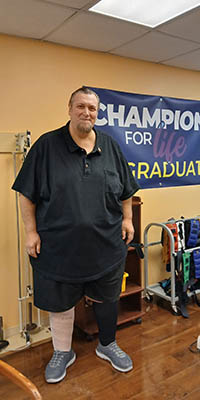
“After the surgery, I honestly thought I would have a deformed foot. But as the foot healed, I can honestly say my right foot looks just like my left foot. I’m blown away by the results.”
Weight loss becomes part of the healing process
Charles’ successful surgery also became a catalyst for broader lifestyle changes. After Dr. Mastay emphasized that weight loss would support his long-term recovery and mobility, Charles made the decision to take control of his health.
“Nobody can make this decision for you. You have to decide it for yourself,” he says. After weighing more than 500 pounds, Charles has lost 80 pounds in just four months through intermittent fasting.
As his strength improves, he has become more mobile, using a wheeled walker for stability and occasionally a cane as he rebuilds endurance and works toward walking longer distances independently.
A message of advocacy and hope
For others facing similar struggles with weight and chronic health conditions, Charles hopes his experience serves as a reminder to listen to your body and advocate for yourself.“I’ve learned if you think something’s wrong—if you have pain or discomfort—take care of it,” he says. “It’s your body’s way of telling you there’s something wrong. Unfortunately, I ignored it, and my whole foot had to be opened up and treated because I waited.”
“I’m one of the lucky ones,” Charles adds. “I had successful treatment and have nothing but praise for Henry Ford, the wound care team, and Dr. Mastay. Every time I see him, I thank him and can’t believe how well my foot has healed.”