


Related News








New clues emerge in understanding pancreatic cancer disparities
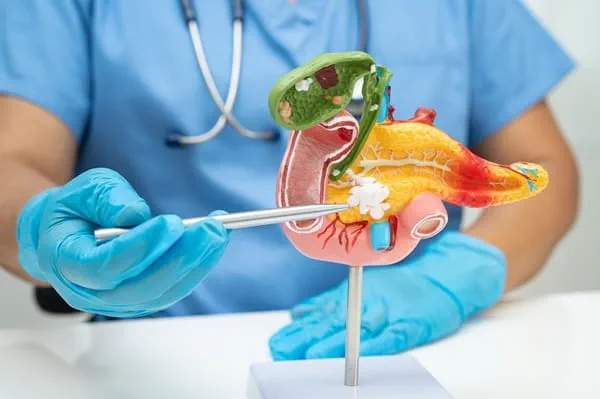
DETROIT – Researchers from Henry Ford Health, Michigan State University and the University of Cincinnati have identified biological differences in pancreatic tumors from Black and non-Black patients, offering new clues about a longstanding cancer disparity and potentially laying groundwork for more personalized approaches to treatment.
The study, published in Cancer Research, began through the Henry Ford Health + Michigan State University Health Sciences partnership and its Pancreatic Cancer Center, then expanded through an ongoing collaboration with the University of Cincinnati. Researchers used patient tumor samples to analyze thousands of biological markers, looking for differences in pancreatic cancer cells and their surrounding tumor environment.
The project took advantage of an important research resource at Henry Ford Health: a pancreatic cancer biobank built from its diverse patient population. Roughly 20% to 25% of pancreatic cancer patients seen at Henry Ford Health and represented in its biobank are Black, giving researchers an opportunity to investigate biological questions that have been difficult to study in less diverse patient populations.
Researchers found that cancer cells from Black and non-Black patients had different molecular signatures. They also found differences in the tumor microenvironment, the collection of cells and other material surrounding and interacting with a tumor.
One notable difference involved B cells, immune cells that normally play a role in the body's defenses. B cells were more abundant in tumor samples from Black patients but also showed more immunosuppressive characteristics, potentially making it easier for cancer cells to evade the immune system. Researchers said more study is needed to determine what role these differences play in pancreatic cancer development and outcomes.
“Our study reveals important differences in the molecular characteristics of pancreatic tumors between Black and non-Black patients, particularly in cancer cell subtypes and the surrounding immune environment,” said Yuesong Wu, a doctoral student in statistics at Michigan State University and lead author of the study. “These findings highlight the importance of including diverse patient populations in cancer research and may help guide the development of more personalized treatment strategies in the future.”
The research brought together investigators from all three institutions. Wu conducted the study’s statistical and bioinformatics analyses under the joint supervision of Yuehua Cui, Ph.D., her doctoral advisor at Michigan State University, and Nina Steele, Ph.D., who began the project at Henry Ford Health and is now at the University of Cincinnati. Cui, Steele and Howard Crawford, Ph.D., scientific director of the Henry Ford + MSU Pancreatic Cancer Center, are senior authors of the study.
“Nina did tremendous work building this project while she was here, and we're fortunate that our collaboration has continued,” Crawford said. “Having access to a diverse collection of patient tumor samples allowed us to look much more deeply at the molecular biology of pancreatic cancer and identify differences that haven't been well characterized in previous studies. Now the important question is what those differences mean biologically and whether they can ultimately help us better understand tumor behavior and treatment response.”
The findings do not suggest that treatment should currently differ based on a patient's race. Instead, researchers say the molecular differences provide new avenues to investigate why pancreatic cancer develops and behaves differently among patients and whether specific tumor characteristics could someday help physicians better select treatments.
The work is continuing at the Henry Ford + MSU Pancreatic Cancer Center. Researchers are studying pancreatic cancer subtypes and examining how tumors evolve from diagnosis through treatment and recurrence, using patient samples to track molecular changes over time.
###
MEDIA INQUIRIES: mediarelations@hfhs.org