.svg?iar=0&hash=F6049510E33E4E6D8196C26CCC0A64A4)

/hfh-logo-main--white.svg?iar=0&hash=ED491CBFADFB7670FAE94559C98D7798)
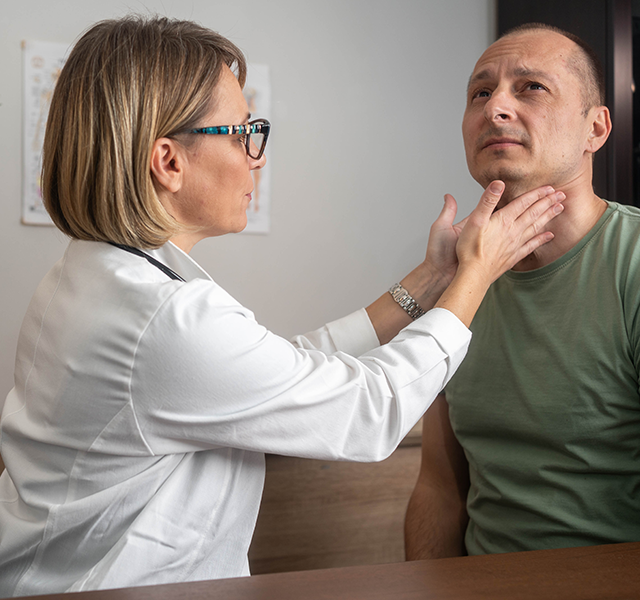
What You Should Know About Thyroid Cancer
In the United States and around the world, rates of thyroid cancer are increasing. Here's why this could be, along with other facts to know about this type of cancer.
Thyroid surgery effectively treats many types of thyroid disorders. At Henry Ford Health, our providers perform a high volume of thyroid surgeries each year, continuously improving surgical techniques and using the latest technology available with a customized approach.
Here you can learn about our approach to thyroid surgery, what surgical techniques and technology we use, how to find your thyroid surgical care team and more.
Thyroid surgery should not be a one-size-fits-all procedure. At Henry Ford, we understand the importance of treating each patient as an individual.
Our thyroid experts evaluate every case to determine the most appropriate treatment. This results in a tailored surgery that helps each patient achieve their treatment goals.
More about what we provide:
When you come to Henry Ford for thyroid surgery, you can expect our thyroid surgeons to use the latest surgical technology. They perform minimally invasive procedures whenever possible to decrease pain and speed up the healing process.
Surgical technologies we use include:
Surgery to remove all or part of the thyroid gland is called thyroidectomy. The thyroid surgeons at Henry Ford Health use thyroidectomy to treat many types of thyroid disorders.
A total or partial thyroidectomy may be the most effective treatment for thyroid disorders, including:
At Henry Ford Health, we work with you to help manage diabetes and teach you new, healthier ways to control your glucose with food, exercise and medicine.
Our team offers many less-invasive alternatives to traditional thyroid surgery, including endoscopic thyroidectomy, also known as minimally invasive video-assisted thyroidectomy (MIVAT). Our doctors are some of the only surgeons in Michigan who perform this procedure.
This procedure uses an endoscope, which is a thin tube that includes a light and a high-definition camera. A small incision is made in the patient’s neck and the endoscope is inserted through the opening.
The endoscope gives a very detailed view of the thyroid gland and many important structures that are near it, including the nerves to the larynx (voice box), the parathyroid glands and major blood vessels.
We use endoscopic thyroidectomy and other minimally invasive procedures to treat patients with a number of thyroid disorders, including:
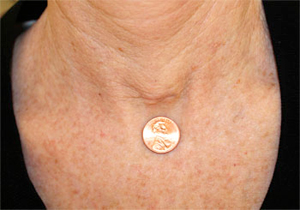
Scar appearance one week after surgery
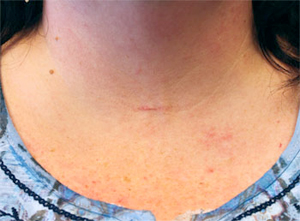
Scar appearance one month after surgery
Most thyroidectomies are successful in treating thyroid disorders. But conditions like thyroid cancer and thyroid goiters sometimes can return after being treated. Thyroid disease that returns after being treated is called recurrent thyroid disease.
If this happens, we may recommend a re-operative thyroidectomy. Re-operative thyroidectomy is a surgical treatment for patients with recurrent thyroid disease.
Previous treatments for thyroid disease can make re-operative thyroidectomy more complicated than first-time treatments. A successful re-operative thyroidectomy requires close communication among the patient, surgeon, and endocrinologist, as well as precise surgical techniques. Fortunately, our doctors have specialized training in performing re-operative thyroidectomies.
Robotic facelift thyroidectomy is an alternative for patients who need to have thyroid-removal surgery. We’re one of just a small handful of programs in the United States that offer this procedure.
A traditional thyroidectomy requires a surgeon to make an incision on the front of the patient’s neck. In a robotic facelift thyroidectomy, the surgeon uses an advanced surgical robot to make an incision behind the patient’s ear, where it is less visible. The surgeon, who controls the robot during the entire procedure, then removes the patient’s thyroid gland through this incision.
Robotic facelift thyroidectomy is a safe alternative to traditional thyroid-removal surgery. Some of the procedure’s benefits include:
In the United States and around the world, rates of thyroid cancer are increasing. Here's why this could be, along with other facts to know about this type of cancer.

Symptoms of hyperthyroidism may be vague and easy to dismiss. Here are 10 signs of an overactive thyroid that may surprise you.

A number of outside factors can throw your hormone levels out of whack and affect absorption of your thyroid medicine. Here are 5 common culprits.

A sluggish thyroid can make you feel run down or increase your chance of gaining a few pounds. Here are 10 lesser known symptoms of an underactive thyroid.
We use cookies to improve your website experience. By using this site, you agree to our Terms of Use. Read our Internet Privacy Statement to learn what information we collect and how we use it.