.svg?iar=0&hash=F6049510E33E4E6D8196C26CCC0A64A4)

/hfh-logo-main--white.svg?iar=0&hash=ED491CBFADFB7670FAE94559C98D7798)
What You Should Know About Thyroid Cancer
In the United States and around the world, rates of thyroid cancer are increasing. Here's why this could be, along with other facts to know about this type of cancer.
Radiofrequency ablation (RFA) is an innovative nonsurgical option to treat thyroid growths (nodules). At Henry Ford Health, this approach offers excellent results with fewer side effects and a lower risk of complications.
Historically, surgery was the only option to treat thyroid nodules. Surgery is effective, but it comes with risks and leaves a scar. Now, Henry Ford Health offers RFA, a highly effective nonsurgical option.
The Henry Ford Health difference:
RFA is a minimally invasive treatment that uses controlled heat to shrink and destroy thyroid nodules. It can be an effective alternative to surgery for some patients. The procedure is quick and painless, and you can resume your usual activities right away.
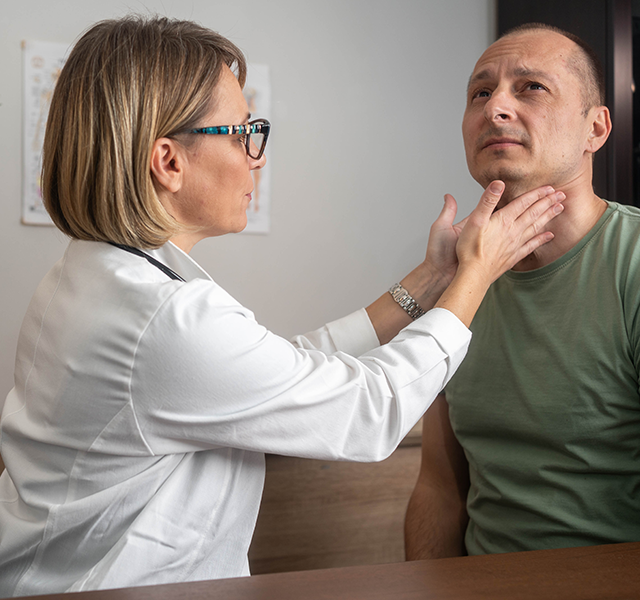
RFA is a treatment for thyroid nodules. Thyroid nodules are solid or fluid-filled lumps that develop on the thyroid gland, a hormone-producing gland at the front of your neck. Sometimes, thyroid nodules are cancerous, but usually they’re not (benign).
Even when thyroid nodules are benign, they can still cause problems such as:
RFA shrinks thyroid growths while preserving healthy thyroid tissue. It’s an outpatient procedure, which means you return home the same day with minimal downtime. Other benefits of RFA include:
On the day of your RFA procedure, you come to the clinic. You lie on your back with your head on a cushion and your neck extended. Then, your thyroid surgeon:
1. Gives local anesthesia around your thyroid so you don’t feel anything during the procedure
2. Inserts a thin needle with an electrode into the thyroid nodule
3. Uses carefully controlled heat that flows through the electrode to destroy the nodule
4. Removes the needle and places a small bandage over the treatment area
You will be able to breathe, swallow and speak normally throughout the procedure. Your doctor will ask how you’re doing and can make adjustments if you’re uncomfortable.
RFA is generally a short procedure. The exact time can vary based on the size and location of the nodule. Generally, you can expect RFA to last between 15 to 60 minutes.
RFA treats benign thyroid nodules that are causing discomfort, swelling or other symptoms. It’s not appropriate for people who are pregnant or have cardiac pacemakers.
Surgeons may use local anesthesia to numb the area around your thyroid. You may feel some pressure, but you won’t feel pain or heat during the ablation.
RFA is a low-risk procedure, and most people don’t have side effects. Rarely, it can cause some mild symptoms such as temporary voice changes, bruising or infection. It can also cause changes in thyroid hormone levels, which are usually temporary.
After RFA, your immune system breaks down the nodule and removes it as waste. Most people notice that their nodules shrink significantly within two to three weeks.
In the United States and around the world, rates of thyroid cancer are increasing. Here's why this could be, along with other facts to know about this type of cancer.

Symptoms of hyperthyroidism may be vague and easy to dismiss. Here are 10 signs of an overactive thyroid that may surprise you.

A number of outside factors can throw your hormone levels out of whack and affect absorption of your thyroid medicine. Here are 5 common culprits.

A sluggish thyroid can make you feel run down or increase your chance of gaining a few pounds. Here are 10 lesser known symptoms of an underactive thyroid.
We use cookies to improve your website experience. By using this site, you agree to our Terms of Use. Read our Internet Privacy Statement to learn what information we collect and how we use it.