.svg?iar=0&hash=F6049510E33E4E6D8196C26CCC0A64A4)

/hfh-logo-main--white.svg?iar=0&hash=ED491CBFADFB7670FAE94559C98D7798)
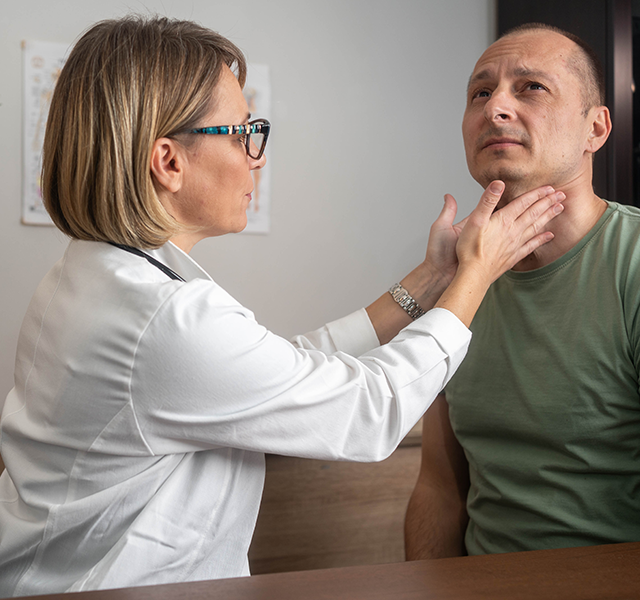
What You Should Know About Thyroid Cancer
In the United States and around the world, rates of thyroid cancer are increasing. Here's why this could be, along with other facts to know about this type of cancer.
The thyroid gland is shaped like a butterfly with "wings" that wrap around your windpipe. It releases hormones that regulate many important body functions. Our doctors are specially trained to diagnose and treat all types of thyroid disorders.
The thyroid doctors at Henry Ford Health are specially trained to diagnose and treat all types of thyroid disorders. We take time to answer your questions and discuss all available treatment options.
Here you can learn about our approach to thyroid disorder care, more information about how the thyroid works, the treatments we offer, how to find your care team and more.
Our experts are leaders in thyroid treatment, offering a level of experience that leads to better patient outcomes. The entire team specializes in tailoring care to your needs, using the latest advanced technologies and treatments.
More about what we provide:
Find information about how the thyroid gland works and how disorders develop below:
When it’s functioning properly, the thyroid gland produces triiodothyronine (T3) and thyroxine (T4), hormones that control your metabolism. Those hormones affect how quickly your body burns calories as well as other functions, like how fast your heart beats.
The pituitary gland, located at the base of the brain, releases thyroid stimulating hormone (TSH). This controls the amount of T3 and T4 the thyroid produces.
When thyroid hormone levels are low, the pituitary gland signals the thyroid to produce more by releasing more TSH. When levels are high, the pituitary gland tells the thyroid to slow down production by releasing less TSH.
Thyroid disease can occur when the gland produces too much or too little T3 and T4. This upsets your body’s hormonal balance. It affects your metabolism, causing weight gain or loss and other symptoms.
Thyroid disease can also result from structural issues, such as a thyroid goiter, nodule or tumor.
Graves’ disease is an autoimmune disorder. This means that your body’s immune system mistakenly overstimulates your thyroid gland, causing it to produce too much thyroid hormone. The condition can also cause eye problems, such as bulging, tearing, dryness and vision changes.
Graves’ disease is the leading cause of hyperthyroidism. The autoimmune disorder affects about 1 in 200 people, usually before the age of 40. The disease often runs in families, and women are up to eight times more likely than men to develop it.
The thyroid specialists at Henry Ford Health are experts at diagnosing Graves’ disease. We successfully treat patients throughout Michigan and beyond.
People with Graves’ disease have a thyroid gland that produces too much thyroid hormone. This overproduction can result in symptoms such as:
During a physical exam, your doctor may notice an enlarged thyroid gland. Blood tests that measure levels of thyroid hormones can confirm if you have hyperthyroidism.
To determine if Graves’ disease is the cause of hyperthyroidism, you and your doctor will discuss family history and symptoms you’re experiencing. Often, blood tests are needed to help confirm the diagnosis.
The thyroid gland produces hormones that regulate a number of bodily activities, including metabolism, or how your body uses energy. When the thyroid makes too much of these hormones, it results in hyperthyroidism, or an overactive thyroid gland.
Hyperthyroidism is much more common among women. Studies estimate that women are 10 times more likely than men to experience hyperthyroidism.
The condition can result from an overactive nodule, multiple nodules or Graves’ disease. The thyroid specialists at Henry Ford Health diagnose and treat hyperthyroidism in hundreds of patients every year.
People with an overactive thyroid gland produce too much thyroid hormone. Having too much thyroid hormone can result in symptoms such as:
Blood tests that measure levels of thyroid hormones can confirm if you have hyperthyroidism.
See the treatment section further on this page for information on how we treat hyperthyroidism.
A goiter is another way to describe an enlarged thyroid gland. While some goiters grow because of too much thyroid hormone, most occur when the thyroid is functioning properly.
Goiters are much more common in women than in men, and they occur most often in women over age 40. A family history of goiter also increases your chance of having one. If you have an enlarged thyroid, the specialists at Henry Ford Health can help.
You may have a thyroid goiter without having any symptoms. Many patients experience symptoms because the size of the gland puts pressure on other parts of the neck.
As it grows larger, a thyroid goiter may cause symptoms such as:
Your doctor may diagnose an enlarged thyroid gland during a routine physical exam. Goiters are also sometimes found on imaging tests, like an MRI or CT scan.
After a goiter is diagnosed, the next step is to determine what’s causing the thyroid to grow. Tests may include:
Solid or fluid-filled lumps that grow in the thyroid gland are called nodules. More than 90 percent of thyroid nodules are benign (noncancerous).
These growths are common and affect about half of people aged 60 or older. Women are more likely than men to develop thyroid nodules. If you suspect you have a thyroid nodule, turn to the thyroid experts at Henry Ford Health for an accurate diagnosis and effective treatment.
Many people with a thyroid nodule don’t even know it’s there.
If a nodule is large enough, it can form a goiter. Patients with larger or multiple nodules can have symptoms due to the size of the goiter. These can include:
If the nodule is overactive and causes hyperthyroidism, you may experience symptoms such as:
Your doctor may diagnose a thyroid nodule during a routine physical exam. Thyroid nodules sometimes show up on imaging tests, like an MRI or CT scan.
To determine if the nodule is causing problems, your doctor may recommend additional tests, including:
We provide a variety of treatments to treat thyroid disorders. Learn about your options below:
Left untreated, hyperthyroidism can lead to numerous other health issues, including osteoporosis and heart problems.
In many cases, medications or oral radiation treatment are often enough to help regulate your thyroid. These treatments include:
If medications fail to control your condition, we may recommend a thyroidectomy. During this surgery, we remove all or part of the thyroid gland. After surgery, you may need replacement hormones to restore balance to your metabolism and other functions controlled by thyroid hormones.
In many cases, Graves’ disease does not require thyroid surgery. Endocrinologists can use medications to regulate hormone production.
But sometimes you need other treatment to normalize thyroid hormone levels. We may recommend radioactive iodine or a thyroidectomy if:
During a thyroidectomy, our surgeon removes all of the thyroid gland. After surgery, you need replacement hormones to restore balance to your metabolism and other functions controlled by thyroid hormones.
Most benign thyroid nodules don’t require any treatment.
If you have a nodule that is large enough to cause breathing or swallowing problems, you may need thyroid surgery. You may also need surgery if a nodule is cancerous. Our skilled thyroid surgeons use advanced, minimally invasive methods to successfully remove thyroid nodules.
In the past, surgery was the only option to deal with this problem. While surgery is effective, it does leave a scar and it has risks. Henry Ford now offers a minimally invasive medical procedure that treats thyroid nodules, called radio frequency ablation (RFA). This non-surgical treatment option is appropriate for some patients, and we will evaluate this treatment option with you.
In the United States and around the world, rates of thyroid cancer are increasing. Here's why this could be, along with other facts to know about this type of cancer.

Symptoms of hyperthyroidism may be vague and easy to dismiss. Here are 10 signs of an overactive thyroid that may surprise you.

A number of outside factors can throw your hormone levels out of whack and affect absorption of your thyroid medicine. Here are 5 common culprits.

A sluggish thyroid can make you feel run down or increase your chance of gaining a few pounds. Here are 10 lesser known symptoms of an underactive thyroid.
We use cookies to improve your website experience. By using this site, you agree to our Terms of Use. Read our Internet Privacy Statement to learn what information we collect and how we use it.