.svg?iar=0&hash=F6049510E33E4E6D8196C26CCC0A64A4)

/hfh-logo-main--white.svg?iar=0&hash=ED491CBFADFB7670FAE94559C98D7798)
Albert's Story
After Decades of Progressive Hearing Loss, a Westland Resident Finds Renewed Hope Through Cochlear Implants
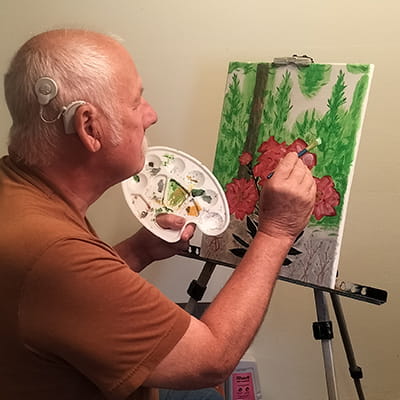
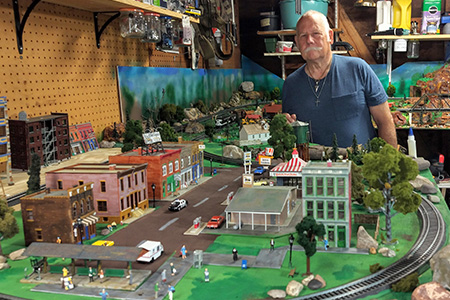
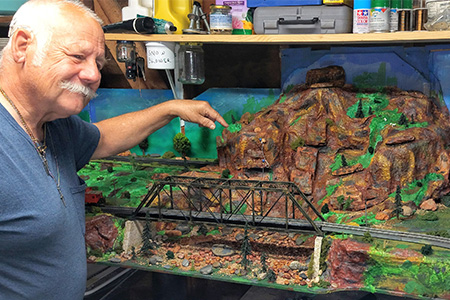
For most of his life, Albert Turley lived with progressive hearing loss. Yet despite the challenges, the Westland resident never let it define him or prevent him from pursuing the hobbies he loves. Whether building miniature model trains and wooden airplane kits, painting, golfing or tending his flower gardens, Albert has always found joy in staying active and creative.
Originally from Alabama, Albert spent the early part of his career in structural steel fabrication and welding. After relocating to Michigan, his passion for gardening led him to Hickory Creek Golf Club, where he plants and cares for flowers while also maintaining the club's groundskeeping equipment.
A lifetime of hearing loss
Albert was just 27 years old when he first noticed his hearing was rapidly deteriorating.
Although he knew he needed medical attention, limited insurance coverage prevented him from seeing a hearing specialist for several years.
"My sister, Kathy, was able to help me get an appointment to see a hearing specialist in late 1989," Albert recalls. "At that time, they identified my rapid hearing loss was due to degenerative auditory nerves. Unfortunately, my hearing loss kept getting progressively worse until I was no longer able to benefit from hearing aids at all."
Over time, conversations became increasingly difficult, and eventually hearing aids no longer provided meaningful benefit.
A new beginning at Henry Ford Health
 Everything changed in 2021 when Albert switched his health insurance and established care with a new primary care physician at Henry Ford Health.
"It's the best move I ever made!" he says.
His physician referred him to Chelsea Conrad, AuD, an audiologist at Henry Ford Health, for a comprehensive hearing evaluation and cochlear implant candidacy assessment. Cochlear implants bypass damaged parts of the inner ear and directly stimulates the auditory nerve, allowing individuals with severe-to-profound hearing loss to perceive sound and understand speech.
When Dr. Conrad first met Albert in 2023, his hearing loss had reached a profound level.
"Albert had zero functional hearing," she explains. "He was relying on lipreading or a speech-to-text transcription app because his hearing aids only allowed him to feel vibrations—they did not provide any true speech understanding."
As part of his comprehensive care and evaluation for the cochlear implants, Albert also met with Kristen Angster, M.D., an otolaryngologist specializing in hearing loss and ear disorders. “By the time we saw Mr. Turley it had only been a few years since he last used his hearing aids,” she explains. “Ideally we would like to get the implant placed within 5 years of loss of “functional hearing,” the point where hearing aids are no longer helpful- but the sooner the better!” Fortunately, Albert qualified for the cochlear implants and moved forward with surgery, hopeful that the procedure could restore the sounds he had been missing for decades.
The journey to better hearing
Albert’s first cochlear implant was done on his left ear. “We typically do bilateral surgeries for adults 6-18 months between the first ear and the second. This gives the brain time to adjust to the first implant which can take 6-24 months depending on the type of hearing loss,” notes Dr. Angster. At first the implant sounds robotic but with continued use the sound quality becomes more natural. “Mr. Turley had zero measurable hearing from either ear prior to surgery so his brain was hungry for sound input and thus adapted very quickly to the implant. All patients adapt to the sound on their own timeline, some very quickly, some more slowly. It was awesome to watch him go from zero hearing to normal conversations after his implants,” she adds.
"I had so much improvement after my first surgery," Albert says enthusiastically.
Once his implant was activated and programmed, the experience was unlike anything he had heard before.
"At first, everything sounded robotic—almost like I was underwater," he says. "After the second surgery and programming, it still sounded metallic at first."
Dr. Conrad explains that while the brain needs time to adapt to the new way of hearing, Albert experienced encouraging results almost immediately.
"When we activated Albert's first implant, he was immediately able to understand speech and no longer required the speech transcription app on his phone," she says.
With several months of listening experience, follow-up programming appointments and adjustments to both implants, Albert's hearing continued to improve dramatically.
"I can tell right away if either of my implants has dislodged or come off," he says. "I can hear all sounds so much better now than before."
Rediscovering the sounds of life
 Today, Albert says the greatest gift has been reconnecting with the sounds of everyday life.
He is equally grateful for the care he received throughout his journey.
"Every doctor, nurse and staff member I encountered along the way was top notch," he says. "Dr. Conrad and Dr. Angster were one in a million, going beyond any doctors I have ever met."
Reflecting on his experience, Albert says cochlear implants have transformed his life in ways he never imagined.
"This experience has been such a profound improvement in my life—more than I can express. When you cannot hear, you miss out on so much of life—the life that is all around you in sounds!”