.svg?iar=0&hash=F6049510E33E4E6D8196C26CCC0A64A4)

/hfh-logo-main--white.svg?iar=0&hash=ED491CBFADFB7670FAE94559C98D7798)
A Life-Changing Turn: Neurostimulation Brings Dramatic Relief from Epilepsy
Although there were early hints of seizure activity, Ryan Marshall recalls the moment of his first major episode vividly—or rather, the aftermath of it. At 21, in 2014, he suffered a grand mal seizure while at a nightclub.
“My friends that were with me at the time called my parents to let them know what was going on. I ended up at the hospital after having a grand mal seizure, but I have no memory of that,” he says.

From that point forward, Ryan’s seizures became more frequent and more disruptive. His father, Joel, explains how significantly the condition affected his son’s life.
“It’s been estimated that Ryan was having about 300 seizure activities per day, with noticeable seizure episodes about every other week.”
When treatment falls short
For several years, Ryan, a hiker who enjoys video games and working with computers, tried multiple antiseizure medications. But like many patients with drug-resistant epilepsy, he found limited relief. The medications also brought significant side effects, including drowsiness and lethargy.
“It’s like I was living in a nursing home, completely relying on my family to take me to the bathroom and do everything,” he says.
As his quality of life declined, Ryan and his care team began searching for other options. Traditional epilepsy surgery was ruled out because his seizures originated from both sides of the brain, making him a poor candidate for that approach.
Exploring new possibilities with neurostimulation
With surgery no longer an option, Ryan’s physicians in Canada introduced him to neurostimulation therapies. One available option was vagus nerve stimulation (VNS), which sends regular, mild electrical pulses to the brain through the vagus nerve to help prevent or reduce seizures.
Initially hesitant, Ryan and his family took time to consider the therapy. During that process, his neurologist also mentioned and recommended another potential option: the Neuropace Responsive Neurostimulation (RNS®) System.
While both VNS and RNS® therapies use neurostimulation to treat epilepsy, they function differently. VNS delivers stimulation at regular intervals, while the RNS® System is responsive—detecting abnormal brain activity and delivering stimulation only when needed. Clinical studies have shown that responsive neurostimulation can offer faster and greater seizure reduction with fewer stimulation-related side effects, such as hoarseness or coughing.
A setback and a path forward
While the RNS® System offered promise, it was not available in Canada. However, Ryan’s neurologist identified an option across the border: Henry Ford Hospital in Detroit, home to a leading Comprehensive Epilepsy Center and the first hospital in Michigan to offer the technology.
After securing insurance approval in Canada, Ryan moved forward with RNS therapy in 2024. He underwent implantation with Ellen Air, M.D., chair of Neurosurgery at Henry Ford Health.
“The ability to treat both sides of the brain without further impairing memory and cognition made RNS an excellent treatment option for Ryan,” expresses Dr. Air. She explains that an electrode was placed into the area of the brain on each side where seizures start, then connected to a small computer that sits in the skull. “The computer constantly analyses his brain signals and detects the very early signs a seizure is starting. It then sends a counter signal to suppress the seizure.”
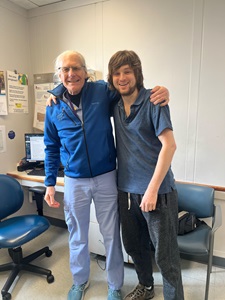
Following the procedure, Henry Ford neurologist Gregory Barkley, M.D., managed Ryan’s ongoing care, including activating the device and carefully adjusting the stimulation settings over time. These adjustments—tailored alongside Ryan’s medications—were designed to maximize seizure control while minimizing side effects.
Dr. Barkley emphasizes that this gradual, personalized approach is key to achieving the best outcomes.
“The RNS system actively suppressed seizure development, firing about 1000 times per day to stop abnormal discharges, called spikes, from spreading into seizures.,” says Dr. Barkley. “On his worst days Ryan was experiencing clusters of up to 300 seizures per day but his seizure activity has been dramatically reduced to the point of having only a few isolated seizures over a 14-month period.”
A new level of independence
For Ryan, the results have been transformative.
“I have gone from not being able to function normally to being much more independent,” he says. “My medications, which caused side effects, have been reduced from five to three, and the frequency of seizures has decreased after each adjustment. I feel there is great hope for the future.”
His father has seen the difference firsthand—and calls the outcome remarkable.

“We were initially told it may reduce seizure activity by about 70 to 80 percent, but we’re seeing more than a 90 percent reduction, which we consider a miracle,” Joel says. “We are so grateful to Dr. Air, Dr. Barkley and the Henry Ford team for the care and successful treatment Ryan received.”
Looking ahead and giving others hope
Joel hopes that more patients in Canada will gain access to advanced neurostimulation therapies like the one that changed his son’s life.
“We hope more people, including Canadians, are able to benefit from this amazing technology in the future,” he says.
While Ryan will likely need fewer follow-up visits in Detroit over time, the experience has left a lasting impression on both father and son.
“We had not visited Detroit prior to this journey and have fallen in love with the city and its architecture,” Joel adds. “It’s a great place to explore.”