.svg?iar=0&hash=F6049510E33E4E6D8196C26CCC0A64A4)

/hfh-logo-main--white.svg?iar=0&hash=ED491CBFADFB7670FAE94559C98D7798)
Night and Day
In a matter of months, Mike went from feeling perfectly healthy to wondering if he’d be in pain and bedridden for the rest of his life.
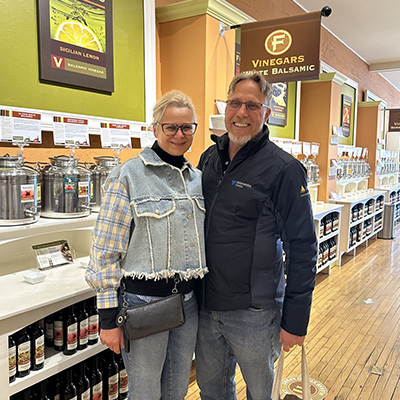
When he was 60, Mike, a Wyandotte resident and maintenance manager, contracted Legionnaires’ disease, a type of severe pneumonia. After his stay at another local hospital, he suddenly developed high blood pressure.
“I would have pain in my legs while I walked and had to take a lot of breaks,” Mike says. “I was shocked, because I didn’t have any cardiovascular issues before this, and nothing in my family medical history.”
Mike was referred to a local heart and vascular team, and they ran several tests.
“It was a lot of back and forth,” Mike says. “I wasn’t getting answers, and it was difficult to get appointments quickly or keep them – or even get approvals to do certain things. At that point, I started to search for another doctor.”
A different experience
One of Mike’s tests had indicated his blood had high levels of creatinine, a waste product of creatine – which helps your muscles produce energy. Some level of creatinine in the blood is normal, but when it’s too high, it may indicate that your kidneys are not functioning well enough to filter this chemical out of your blood.
For males, anything above 1.2 milligrams per deciliter (mg/dl) is considered high. Mike’s had reached 3.6 mg/dl.
Ultimately, he found Bharathi Dukkipati, M.D., a Henry Ford Health nephrologist, or kidney specialist, at Henry Ford Medical Center – Taylor. After some additional testing, Dr. Dukkipati referred Mike to Brian Sullivan, M.D., a vascular surgeon at Henry Ford Wyandotte Hospital, for further investigation and treatment of renovascular hypertension, or high blood pressure that develops from the kidneys not receiving enough blood. Renovascular hypertension is a type of secondary blood pressure that is caused by another medical condition.
After reviewing Mike’s test results and listening to his medical history, Dr. Sullivan suspected that he might have a rare condition known as aortic occlusion. The aorta is the largest artery in the body, and it runs from the heart down to the abdomen, supplying blood to the body. When it becomes blocked, or occluded, it can cause different conditions depending on where the blockage is. If it’s located in the section that feeds the kidneys, it can cause renovascular hypertension.
Additional tests, including checking the blood flow in Mike’s limbs as well as scans of his chest and the renal arteries that feed the kidneys, confirmed Dr. Sullivan’s suspicion and gave Mike the answers he was looking for.
“The experience I had with the Henry Ford team was dramatically different,” he says. “Once they zeroed in on the issue, they moved fast. A week after my last test, Dr. Sullivan called me with the news about my aorta.”
Revealing a hidden threat
 The section of Mike’s aorta located below the renal arteries was abnormally small, a condition that he likely had his entire life.
“I had no idea,” Mike says. “It’s possible that other arteries in my body had compensated for this smaller section of my aorta over the years, growing around it to keep my blood flowing normally.”
It may have been his Legionnaire’s disease that led to the blockage. But once it happened, this began cutting off the blood flow to his renal arteries and his blood pressure started to spike.
“Dr. Sullivan told me he didn’t even know how I was still walking around,” he says. “My condition was so severe that I would need surgery.”
Given the complexity, Dr. Sullivan would also need to combine two large operations into one. First, an aortic endarterectomy. This open procedure would cut out a section of Mike’s aorta below his renal arteries. Then, an aortobifemoral reconstruction, using a graft, or synthetic tube, to replace the removed section of the aorta and restore normal blood flow.
“I was devastated,” Mike says. “But Dr. Sullivan was upfront and laid it out for me. He didn’t downplay it. He wanted to make sure I understood this was a major surgery, and that with something like this there are risks. But without it, he told me there was a good chance I would have to go on dialysis, be in pain and eventually bedridden, with a poor life expectancy.”
Mike thought about it for a day, then decided to do it.
“The way Dr. Sullivan spoke, the way he carried himself, he was very confident in what he could do,” Mike says. “While there were no guarantees, he said I was a good candidate because I was in pretty good shape and my heart was strong. He made me feel at ease.”
Once Mike committed to the surgery, his team moved fast, again. Just two weeks later he was at Henry Ford Hospital in Detroit.
Typically, an aortic endarterectomy is performed through the abdomen. But with the abnormal growth of Mike’s blood vessels around the renal arteries, Dr. Sullivan would need to use an alternate approach.
“Instead, he went through my side, from my belly button all the way to my back,” Mike says. “While it was a major surgery, I was comfortable with everything. There were probably 14 people in the operating room, everyone knew exactly what they were doing and they were in an upbeat mood. I said a prayer with them before we started.”
Recovering, and reflecting
 Over 10 hours later, Mike was in recovery.
“When I woke up, I was hanging from a basket as they transferred me to a bed,” Mike says. “I don’t remember much after that. I was completely out of it the next few days from the medication.”
Mike stayed at Henry Ford Hospital for almost two weeks, working with physical therapists and using a walker to build up strength again, before he started his recovery at home. At that point, his blood pressure had stabilized, and his creatinine levels had dropped by more than half.
Since then, Mike, now 63, has noticed a significant difference in his quality of life.
“I feel much better,” he says. “I’m not as stressed, I don’t have any leg pain, and I don’t have to take as many breaks. In my job, I’m out in the field quite a bit and I walk about 10,000 steps a day.”
He’s also getting back to other activities where he had to take breaks, such as riding his bike and playing basketball pickup games with friends. His friends and family have also noticed the difference.
“My wife was there with me every day,” Mike says. “She and my daughter, my older brother, everyone I know is amazed how all of this happened and that I’m doing so well,” Mike says.
As he looks back on this unexpected medical journey, Mike is grateful.
“I think I got lucky and God’s watching out for me,” he says. “I think he put me in touch with these people and put my life in their hands. And I can’t say enough about how Dr. Sullivan treated the situation. I was really feeling rejected after my experience with the other care team. Dr. Sullivan treated me with respect and gave me hope. I’ll never say enough about him and Henry Ford. Just the people I’ve met there, and everyone who took care of me. All the times they answered my questions so I could understand my treatment. I don’t know that I would be where I’m at today if I had gone somewhere else.”
“My vascular surgery team gave me answers, and hope. I Am Henry.”