.svg?iar=0&hash=F6049510E33E4E6D8196C26CCC0A64A4)

/hfh-logo-main--white.svg?iar=0&hash=ED491CBFADFB7670FAE94559C98D7798)
Related News








Growing Healthy Habits: GROW Garden Helps Families Facing Feeding Challenges
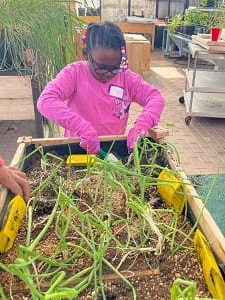
- The GROW Garden at Henry Ford Health uses feeding therapy, gardening and cooking to help children with autism and food-related challenges become comfortable trying different foods.
- During monthly sessions, children spend time in the greenhouse at Henry Ford West Bloomfield Hospital as their parents learn healthy meal ideas from the hospital's culinary team.
- Offered at no cost to Henry Ford Health families, the volunteer-led program aims to build healthy eating habits in a low-pressure, supportive environment.
WEST BLOOMFIELD — For families raising a child with feeding challenges, what ends up on the dinner plate is only part of the story. Mealtimes can turn into battlegrounds, social events centered on food often feel overwhelming, and entire family routines may start to revolve around what a child will or won't eat.
That's why the GROW Garden program at Henry Ford Health takes a whole-family approach. Designed for families with children with autism, feeding disorders, and developmental differences that can complicate eating, the program helps build comfort and confidence around trying new foods while empowering parents with practical strategies they can use at home.
"Food is part of so many important moments in our lives, from family gatherings and school activities to holidays and celebrations," said Dr. Tisa Johnson-Hooper, MD, medical director of the Generational Resilience Opportunity & Wellness (GROW) Center for Autism and Intellectual/Developmental Disabilities at Henry Ford Health. "When a child struggles with selective eating or food avoidance, that can cause friction that ripples through the entire family."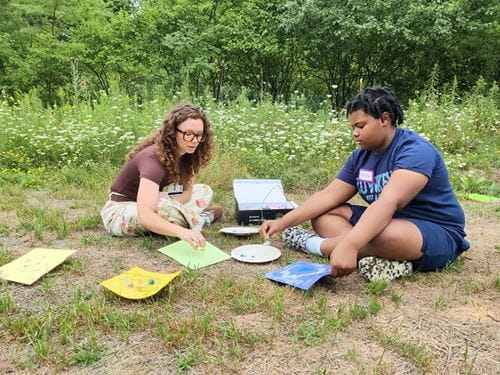
Westland mother Latrease Hiter said the program has helped her family ease stress around food. Her daughter, 7-year-old Harmony Culbreth, has been diagnosed with Avoidant/Restrictive Food Intake Disorder (ARFID) and once refused to eat nearly all vegetables.
"I couldn't get her to eat anything green," Hiter said. "Basically, the only thing she ate was peanut butter and jelly sandwiches and hamburgers."
Since working with a feeding therapist and participating in the GROW Garden, Harmony has gradually started to explore foods she once rejected, including pesto, turkey and yellow squash.
"We've gotten to the point now where she'll at least try them," her mom said. "She's been exploring foods and seeing how they grow. That has really helped."
Building healthy eating habits for a lifetime
The GROW Garden is the brainchild of Brooke Ringler MA, CCC-SLP, a speech-language pathologist at Henry Ford Health who wanted to create a space where children who process the world differently could start building healthy habits that can follow them into adulthood.
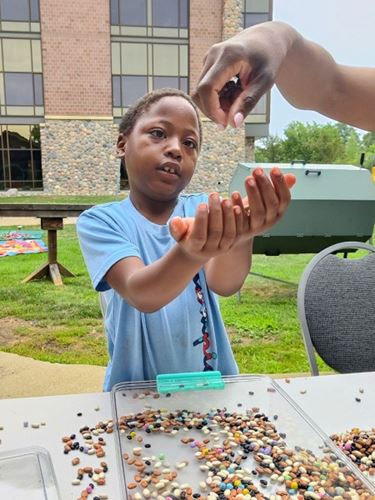
Children with autism are up to 70% more likely to experience atypical eating behaviors, often gravitating toward what they consider "safe" foods with consistent tastes and textures. That can lead to diets that lean heavily on processed foods.
By helping children become comfortable with a wider range of foods early in life, the GROW Garden aims to support healthier eating habits well into adulthood. That's especially important because research suggests that children with autism are more likely than their peers to be overweight or obese, increasing the risk of health issues like high blood pressure, diabetes and heart disease.
"Gardening gives children a chance to interact with food without the expectation that they have to eat it," Ringler said. "They can plant a seed, smell an herb, touch the leaves and watch something grow. Those experiences help take some of the fear or uncertainty out of trying new foods. Doing that alongside their peers creates a supportive environment where they can explore at their own pace."
During the greenhouse sessions, children participate in gardening-themed games, sensory exercises and food activities, such as building mini pizzas or seasoning potato chips with fresh herbs and spices, all with support from trained volunteers.
'It felt like a community for us'
Their parents, meanwhile, attend a mini-cooking class at Henry Ford West Bloomfield Hospital's demonstration kitchen led by Executive Chef Christopher Lawshea and his team. These are intended to provide quick, nutritious meal ideas that families can recreate at home using many of the same ingredients that children are introduced to in the greenhouse.
But beyond recipe ideas, Unique Thomas, of Roseville, said the program also provides a community of people who understand the challenges of raising children with feeding issues. Her 10-year-old daughter, Harper Lawton, who has autism, has participated in the GROW Garden since its pilot phase.
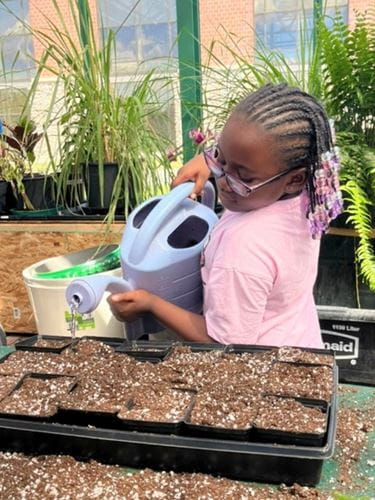
"It felt like a community for us," Thomas said. "We were around other families who understood what we were going through. I learned so many new ways to introduce foods. One idea was taking Harper to the grocery store and letting her pick out the ingredients and then help prepare the meal."
Those lessons have helped Harper explore foods beyond the pizza, chicken nuggets, pancakes, cereal and hamburgers that once made up most of her diet. Parsley, in particular, has become a favorite. After growing it in the greenhouse, Harper began asking to add it to meals at home.
"Now she puts parsley on everything," Thomas said with a laugh.
The GROW Garden is volunteer-led and offered at no cost to Henry Ford Health patients and their families. People interested in learning more about the program or volunteer opportunities can email HarbortownGrow@hfhs.org. The next cohort will meet each Saturday for six weeks, beginning at the end of October.
###
MEDIA CONTACT: mediarelations@hfhs.org