.svg?iar=0&hash=F6049510E33E4E6D8196C26CCC0A64A4)

/hfh-logo-main--white.svg?iar=0&hash=ED491CBFADFB7670FAE94559C98D7798)

Eric's Story
Eric wasn’t getting answers about his extreme arm swelling and pain. Until he sought out the experts at Henry Ford West Bloomfield Hospital, where he had an advanced vascular surgery that got him back to his active lifestyle.
When Eric’s left bicep swelled up so large that it strained his shirt sleeve, he knew something was wrong.
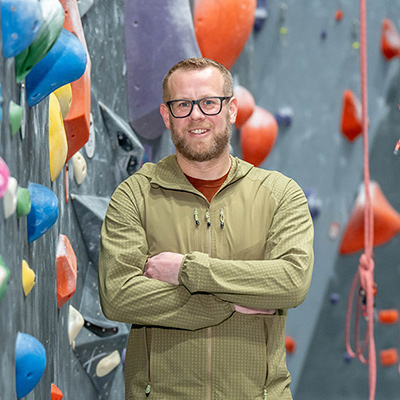
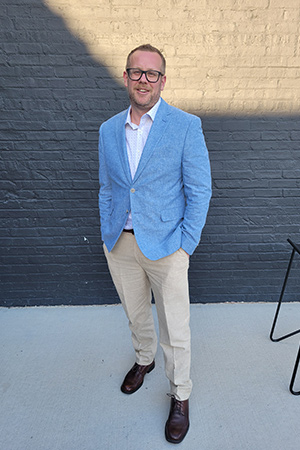
This sudden development was a shock to Eric, then 39, a West Bloomfield resident. He was healthy, had lived a very active life and his only previous medical issues were injuries from football, volleyball, snowboarding and running when he was growing up.
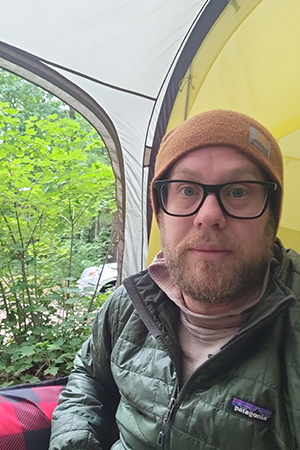
He also loves camping and kayaking, including during trips to northern Michigan, and he’s spent a lot of time on the water.
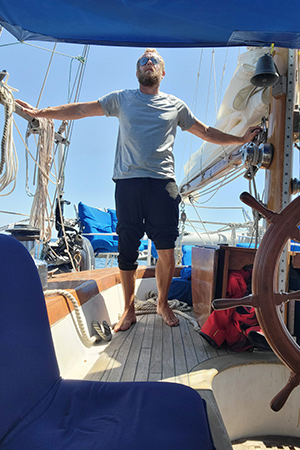
“I’ve been boating my whole life,” he says. “But in the last few years, I started working as a deckhand. In 2023, I went down to Panama to work on a boat, followed by another job in St. Thomas later that year and into Spring 2024.”
After getting back to Michigan, Eric started working at REI and took up rock climbing./p>
But then his bicep swelled up suddenly, and he noticed a throbbing pain anytime he was working out. Eric talked to one of his good friends, a flight medic nurse in the Army, who told him that he needed to get it checked out, right away.

His doctor thought that Eric might have tennis elbow.
“Because of my age and the fact that I’m active and healthy, she didn’t think I had a blood clot,” he says. “But she scheduled an ultrasound for my peace of mind, and it did show a clot.”
His doctor referred Eric to a hematologist, who ordered more tests.
“My mom and sister both got a blood clot once, but they never had issues since then,” Eric says. “The doctor got stuck on that, was sure it was a genetic thing and kept ordering expensive tests. It was also hard to get them to return my phone calls.”
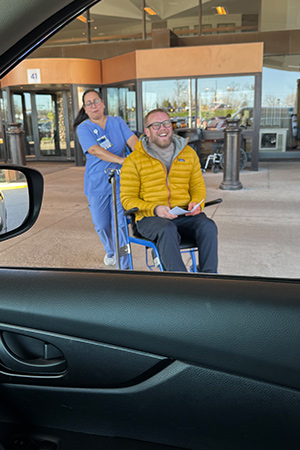
Two months later, Eric’s symptoms had not improved, and he was getting frustrated with the lack of response from his care team. One day, he was at work and started feeling worse, so he drove himself to the Henry Ford West Bloomfield Hospital emergency room.
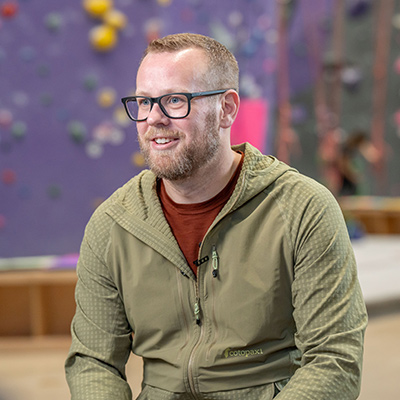 “After examining me and listening to my medical history, the ER doctor suspected that I had something else going on,” Eric says.
The ER doctor told Eric that he was going to consult with one of his colleagues, and 20 minutes later, he gave Eric the contact info for Tamer Boules, M.D., a vascular surgeon at Henry Ford Health.
“He told me that Dr. Boules was expecting to hear from me, and I called his office,” Eric says. “The scheduler said that Dr. Boules didn’t have any openings for three weeks, and I thought I would have to wait again. Thirty minutes later, one of Dr. Boules’ team members called me and told me, ‘You’re coming in Wednesday.’”
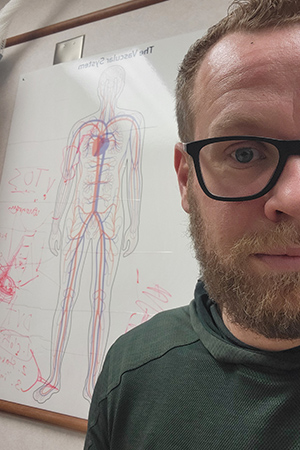
At this initial visit, Dr. Boules told Eric that he suspected he had a condition known as venous thoracic outlet syndrome. The thoracic outlet is the area between your neck and upper chest, formed by your top ribs and framed by your collarbone. When one or more veins in this area gets pinched, it can cause blood clots like the one that Eric was experiencing. Without treatment, it can lead to permanent swelling and chronic pain with activities, especially bothersome to young active patients like Eric.
Additional testing confirmed Dr. Boules’ suspicions, and he recommended that Eric have surgery. Eric’s surgery would be assisted by Dr. Mitchell Weaver, vascular surgeon, who also treats patients with this condition.
“I was finally getting the answers I didn’t get before, and it felt like my Henry Ford care team actually cared,” Eric says. “What I appreciated about Dr. Boules the most is that he laid out my options, breaking things down so I could understand what was going on. He wasn’t just throwing out a bunch of medical jargon. I could either stay on blood thinners forever and be limited in my activities, or I could have surgery. I trusted him and opted to get the surgery done.”
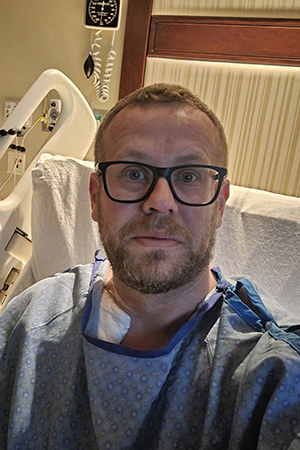
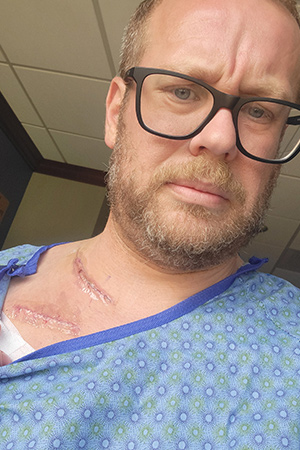
Eric’s surgery involved removing a section of his top rib to relieve the pressure on his vein and clearing out scar tissue caused by the blood clot and vein compression. He spent two nights at Henry Ford West Bloomfield Hospital before being discharged.
 While Eric was very sore during his recovery at home, this wasn’t the hardest part.
“After being so active, it was tough just sitting around,” Eric says. “Other than physical therapy, I was just hanging out for weeks. I couldn’t even drive.”
About six weeks after his surgery, Eric returned to work at REI.
“When I hired on there, it was just meant to be a temporary, seasonal job,” Eric says. “But it’s become more than that. I have some amazing co-workers who called and texted to check on me during my recovery. And my work was really accommodating while I was recovering, making sure I wasn’t going to lose my health insurance after not being at work for so long.”
Eric’s support network also included his parents, who drove him to early morning follow-up appointments and changed his bandages, and friends who drove him to weekly trivia nights.
“This whole process would have been far more difficult if I didn’t have the support of my friends and family,” Eric says. “It really helped with the monotony of recovery.”
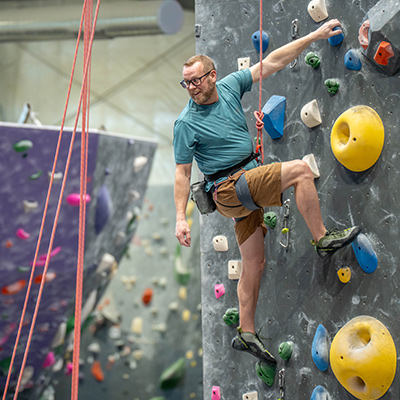
Two months after his surgery, Eric ventured out for his first outdoor activity, a light kayaking trip. And once he was able to get off the blood thinners, Dr. Boules told him he could start rock climbing again.
“Two days after my last follow-up appointment, I did my first day of climbing – on my birthday,” Eric says.
As he looks back on his healthcare journey, Eric is grateful.
“The amount of support I’ve received has truly been a blessing,” he says. “And I’m so appreciative of Dr. Boules and his incredible team. They showed me what a hospital experience should be like.”
We use cookies to improve your website experience. By using this site, you agree to our Terms of Use. Read our Internet Privacy Statement to learn what information we collect and how we use it.